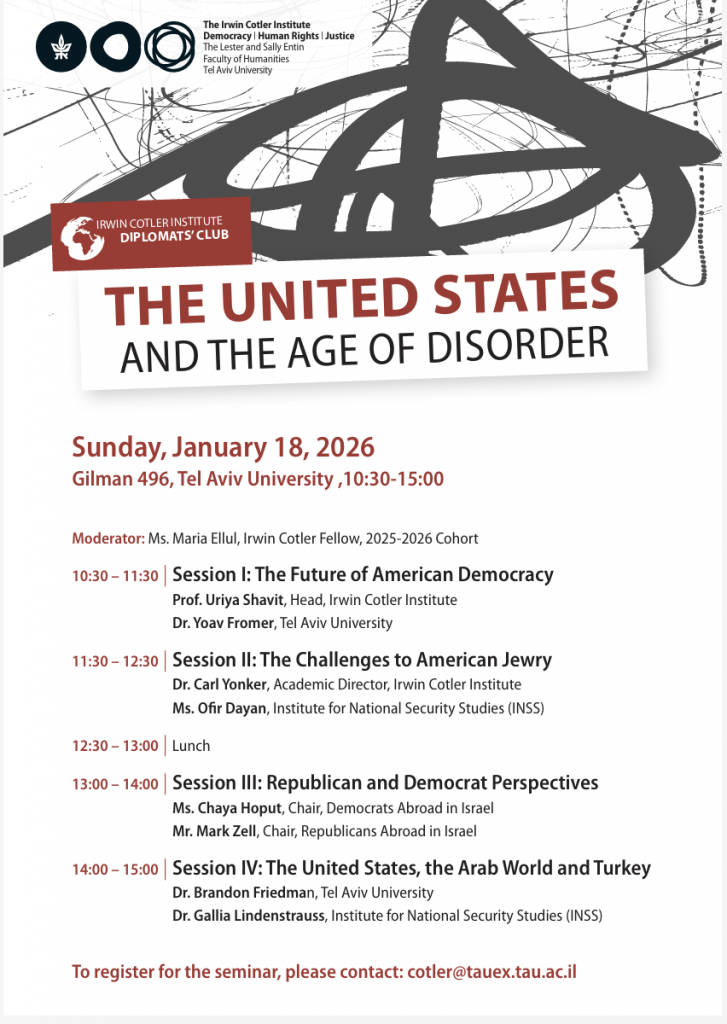
Diplomats’ Club – The United States and the Age of Disorder
On Sunday, January 18, 2026, the Irwin Cotler Institute hosted its second Diplomats’ Club of the 2025-2026 academic year. Attended by over 60 people, including members of 23 delegations from Azerbaijan, Brazil, Chile, China, Cyprus, Egypt, Estonia, Greece, Guatemala, Kazakhstan, Kenya, Latvia, Lithuania, Moldova, Nepal, Nigeria, the Philippines, Romania, Slovenia, Spain, Sri Lanka, Ukraine, and Uzbekistan. The seminar was moderated by Ms. Maria Ellul, a 2025-2026 Cotler Fellow.
The seminar addressed the strategic, political, and normative challenges facing the United States as global order gives way to heightened uncertainty, great-power competition, and regional instability. The opening session focused on the future of American democracy at a moment of deep polarization, institutional strain, and global uncertainty. Prof. Uriya Shavit, the Head of the Institute, opened the seminar with a discussion on the fundamental elements that define a democratic state, raising critical questions about the imprint left by the January 6 Capitol Attack on the American electorate and how this may have shaped voting behaviour in the November 2024 elections. Dr. Yoav Fromer followed with an analysis of the intersection between American democracy and foreign policy, addressing in particular the evolving challenges in U.S.-Israeli relations.
The second session turned to the evolving challenges facing American Jewry across the political spectrum. Dr. Carl Yonker, the Academic Director of the Institute, opened the session with an in-depth examination of the rise of antisemitism in the United States as a byproduct of Christian Nationalism. Using the recent arson attack of the Beth Israel Congregation in Jackson, Mississippi, as a point of departure, Dr. Yonker analyzed the role of three prominent figures in the Christian Nationalism movement: Pastor Rick Wiles, Gab founder Andrew Torba, and streamer Nick Fuentes, who disseminate antisemitic rhetoric and conspiracy theories to millions of followers. Ms. Ofir Dayan, of the Institute for National Security Studies, then examined manifestations of antisemitism on the political left, focusing on its proliferation on American college campuses.
Following a lunch break, the third session featured Israeli representatives of both major U.S. political parties, who offered insight into how Americans residing in Israel and dual nationals exercise their suffrage rights. Ms. Chaya Hoput, the Chair of Democrats Abroad in Israel, opened the session with an overview of the organization’s history and mission. Mr. Marc Zell, the Chair of Republicans Overseas in Israel, similarly outlined his organization’s background and shared perspectives on the current state of U.S.-Israel relations.
The final session explored U.S. engagement with the Arab world and Turkey amid shifting alliances, regional conflicts, and evolving global power dynamics. Dr. Brandon Friedman opened the session with an in-depth analysis of the American relationship with Saudi Arabia. Concluding the seminar, Dr. Gallia Lindenstrauss, of the Institute for National Security Studies, addressed U.S.-Turkey relations, reflecting on how President Erdoğan has been perceived by successive U.S. administrations and highlighting moments when Washington has asserted clear red lines – most notably Turkey’s removal from the F-35 Joint Strike Fighter program following its purchase of Russian S-400 air defense systems.