Why do some political ideologies that gain great public traction fade at one point, as if they never existed, while others continue to thrive despite their failures?
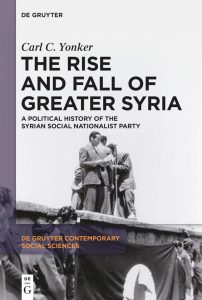
The publication of the book The Rise and Fall of Greater Syria (De Gruyter), authored by the Institute’s Academic Director, Dr. Carl Yonker, provided an opportunity to explore this question during a Zoom seminar on June 1, 2023. The book traces the misfortune of the Syrian Socialist Nationalist Party, a fascist pan-Syrian movement that for a moment seemed to have a real chance of dominating Syrian and Lebanese politics, and then was all but extinguished. Bringing together social scientists and scholars of intellectual history, the seminar will explore comparatively the dynamics that make certain ideologies long-lasting and others – not, in the Middle East and beyond it.
Inauguration Ceremony
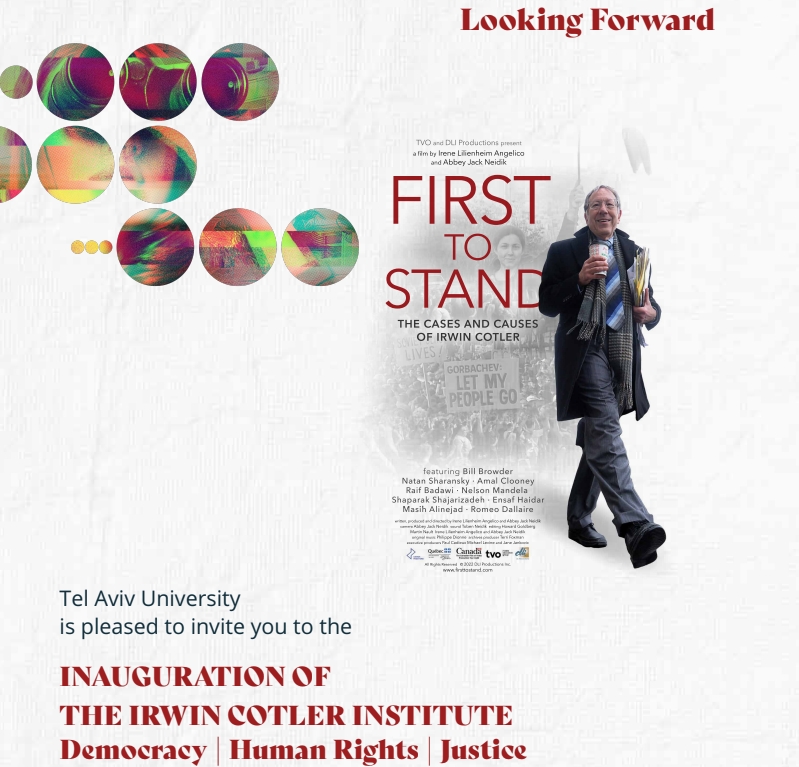
On May 14, 2023, 17:00, exactly 75 years to Israel’s independence, the Cotler Institute for Democracy, Human Rights and Justice was inaugurated in an official ceremony at the Senate’s Conference Hall at Tel Aviv University (TAU).
Celebrating and advancing the legacy of one of the greatest and most respected jurists and advocates of justice and human rights in our time, the Institute provides a unique space for scholars and students from different disciplines who share a passion for advancing freedom and fighting bigotry as well as seek to learn more about the history of Israel and its diversity.
The ceremony was attended by Irwin Cotler, his wife Ariela and their extended family, the President of TAU, Prof. Ariel Porat, Canada’s Ambassador to Israel, Lisa Stadelbauer, and dozens of other distinguished guests.
Cotler Institute Participates in Workshop on Identity and Resilience in Florence
On February 3-4, the Cotler Institute joined TAU’s International Office and its Lowy International School in organizing the workshop “Facing Antisemitism, Building Resilience” in Florence, Italy, attended by dozens of members of Jewish communities in Italy as well as academic scholars and young pro-Israel Italian activists.
A vocal pro-Hamas rally in front of the building where the workshop was held forced much police attention but failed to affect the good order and success of the workshop.
Prof. Uriya Shavit, Head of the Cotler Institute, gave three lectures: on the rise of antisemitism and the means to fight it; Jewish identity in the 21st century; and the current situation of the war in Gaza.
MKs, Police, Scholars and Community activists engage in Dialogue on Over-Policing among Ethiopian Jews
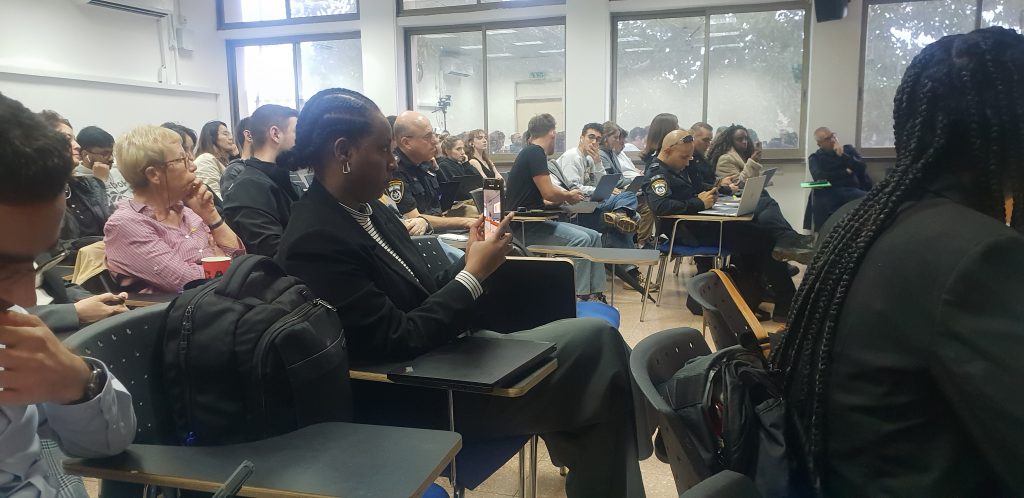
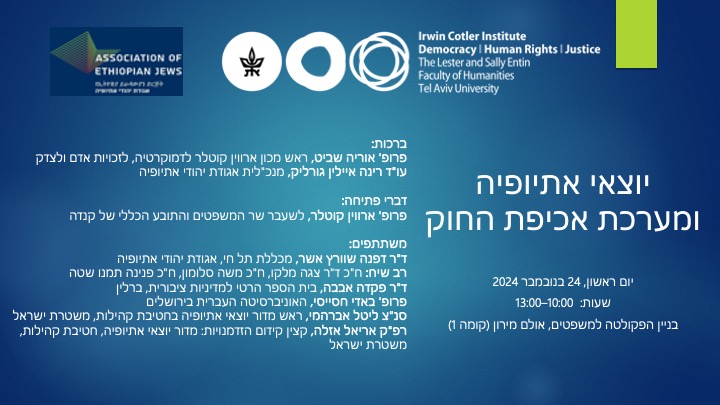
On November 24, 2024, the Irwin Cotler Institute, in cooperation with the Association of Ethiopian Jews (AEJ), hosted a conference on the Ethiopian Jewish community and the justice system in Israel. The conference, taking place at a packed-to-the-brim lecture hall at TAU’s Law Faculty, brought together dozens of lawyers, community activists, students, Irwin Cotler Fellows, professors of criminology, high-ranking officers from the Israeli Police, and members of Knesset to address and to discuss the issue of over-policing.
Prof. Irwin Cotler, Canada’s former Minister of Justice and Attorney General, noted in his opening remarks the timeliness and importance of discussing the issue and his pleasure with the Cotler Institute partnering with the AEJ. Prof. Cotler stressed that over policing is not a phenomenon peculiar to a democracy like Israel, but in Israel it takes on a poignant dimension because it reflects the ongoing experience of Ethiopian Jews and their struggle for equality before the law. Moreover, the test of a just society is how it treats the most vulnerable amongst it.
Prof. Uriya Shavit, Head of the Cotler Institute, and Adv. Rina Ayalin-Gorelik, the AEJ’s Executive Director, offered welcoming remarks. Prof. Shavit noted the importance of dialogue between police and communities in addressing the issue of over-policing and of being informed by comparative academic studies on the matter. Adv. Ayalin-Gorelik noted the painful reality the data in a special report compiled recently by her organization regarding over-policing reveal, and stressed that the struggle for justice and equality before the law is not for the rights of one community alone, but is rather for the rights of all Israelis. She noted that discriminatory treatment by law enforcement harms Ethiopian Jews’ sense of belonging and trust in law enforcement, while criminal records for minor offenses threaten the future opportunities for Ethiopian Jewish youth.
Presenting the AEJ’s special recent report on over-policing, Dr. Daphna Schwartz Asher of the AEJ and Tel Hai College observed that the share of cases opened against Ethiopian Jews of all ages exceeded the proportion of the Ethiopian Jews in the Israeli population (2%). Between 2022 and 2023, the share of cases opened against Ethiopian Jews for assaulting a police officer rose from 4.24% to 5.16% of the overall number of cases nationwide, while the share of cases opened for obstructing a police officer rose from 4.06% to 4.23%.
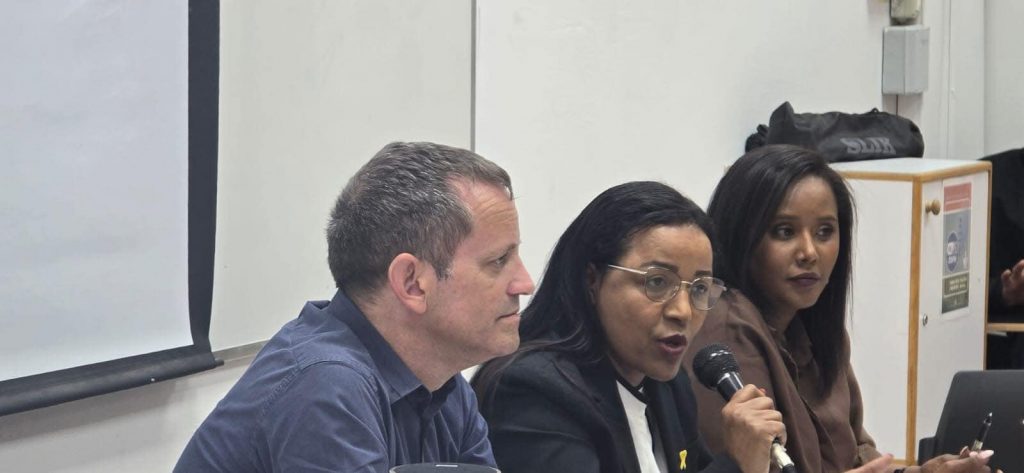
Following Dr. Asher’s presentation, Prof. Shavit chaired a roundtable discussion with two members of Knesset, MK Dr. Tsega Melaku (Likud, in government) and MK Pnina Tamano-Shata (National Unity, in opposition). MK Melaku and MK Tamano-Shata spoke on the recently enacted law in the Knesset to expunge the criminal records of Ethiopian Jews convicted of minor offenses, particularly the broadly-defined offense of “disturbing the public order.” Both also shared their painful personal experiences as mothers of children who have experienced racism and over-policing, and voiced their frustration at what they believe to be the Israeli police’s slowness in changing its interaction with the community and to build trust. They stressed their hope and desire for improvement and belief that advancing the rights of the Ethiopian Jewish community will also positively impact other minority communities in Israel such as Arab Israelis and the ultra-Orthodox.
Following the panel discussion, Dr. Fekade Abebe of the Herti School for Public Diplomacy in Berlin and Prof. Badi Hasisi of the Hebrew University in Jerusalem provided academic perspectives.
Dr. Abebe observed that the topic of over-policing has been addressed in conferences and in other forums over the years and that while there may be broad agreement and goodwill to treat the issue and repair relations between the community and law enforcement, it remains unresolved. The core problem is how the police interact with citizens, particularly minorities. This problem results from several factors, including the inherent and historical connection between the police and the military in Israel; the roles of each are distinct and different, but blurred in the Israel police, leading it to act with too heavy a hand against citizens.
Prof. Hasisi, a criminologist specializing in minority-police relations and profiling, spoke on the importance of data analysis regarding age and gender. Through nuanced analysis, he argued, one can appreciate whether the problem of over-policing impacts a particular segment of a minority population. Prof. Hasisi noted that the AEJ special recent report contains findings that are both negative and positive. One of the most positive trends is the decline in arrests among young Ethiopian Jews. He concluded his presentation with practical advice to the police, including on how to conduct in-person communication with citizens in ways that discharge tensions and build trust and understanding. The advice stirred much interest among the police officers present.
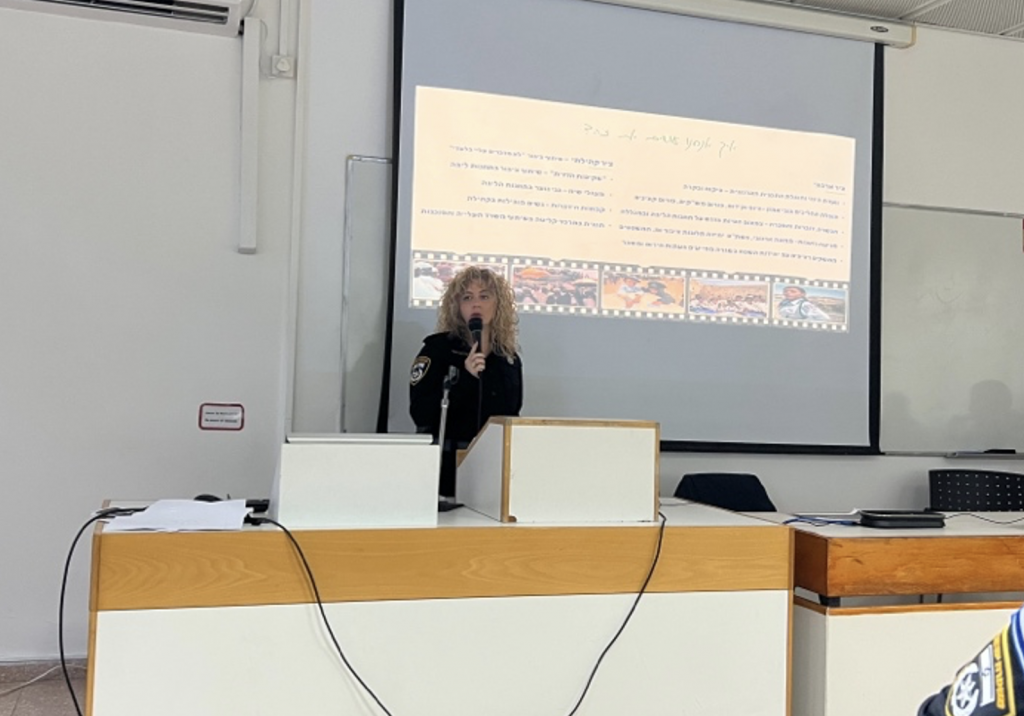
The conference ended with presentations from members of the Israel Police, that was represented by five high-ranking officers. Chief Superintendent Lital Avrahami, head of the department responsible for fostering relations with the Ethiopian Jewish community, acknowledged that significant work remains to be done but noted that when looking at the statistics from the past five years, there are positive trends to build upon, including declines in the number of arrests and cases opened against Ethiopian Jewish youths and minors between 2019 and 2023.