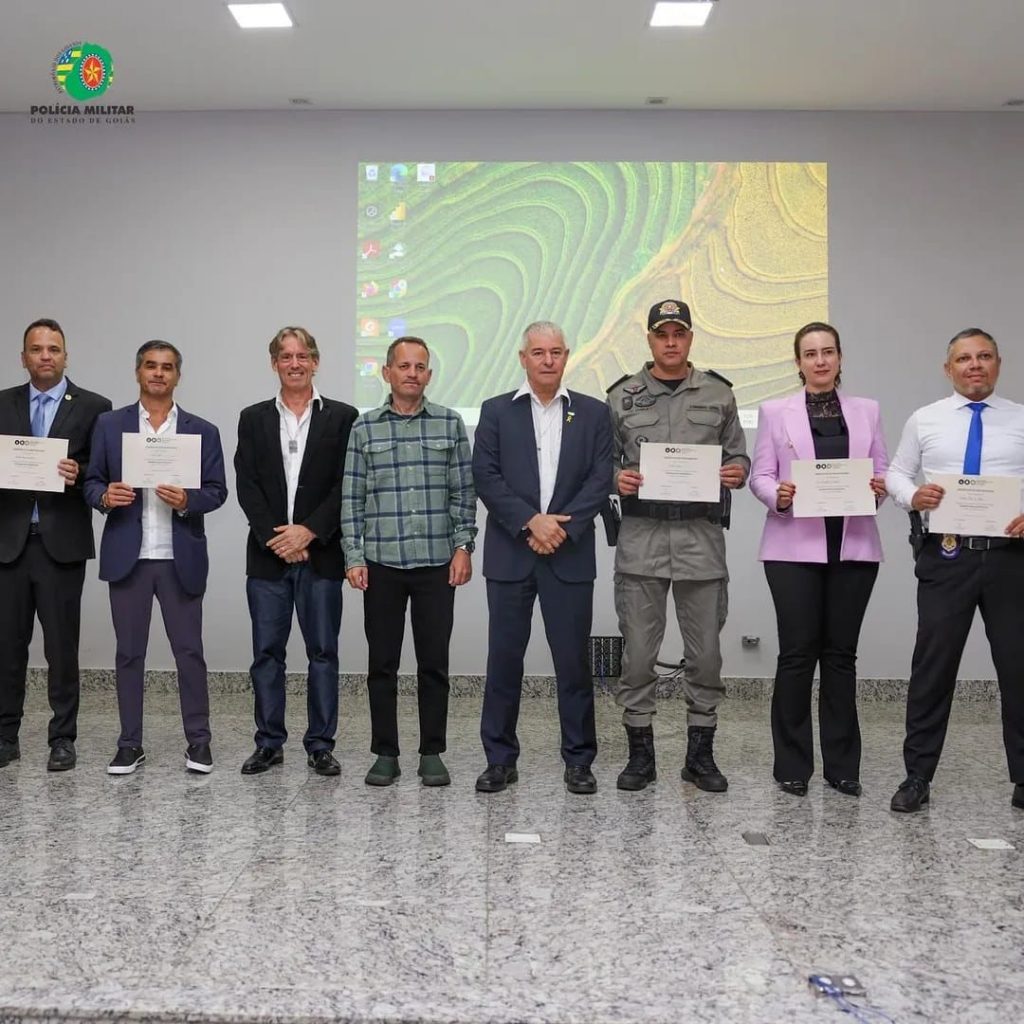
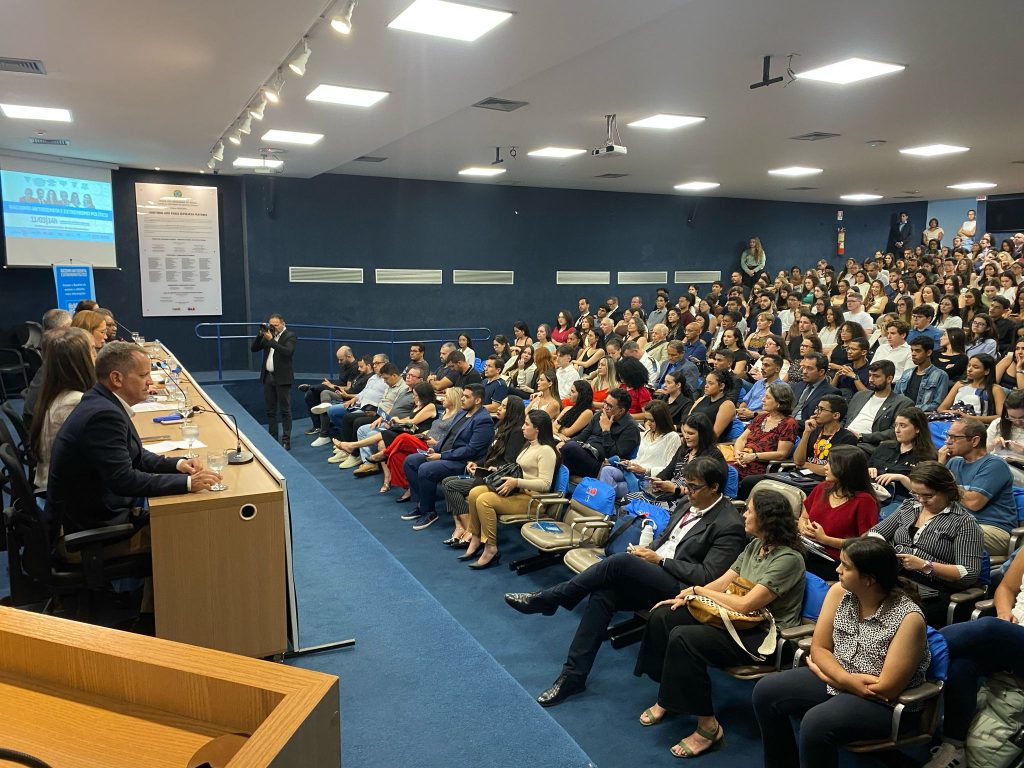
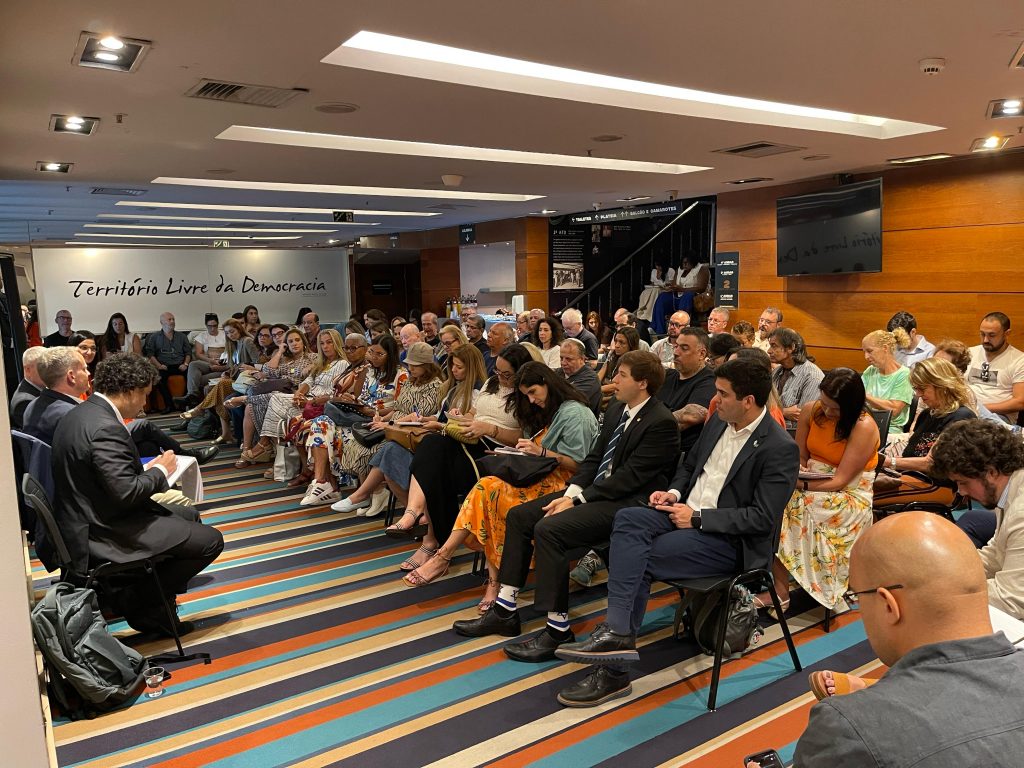
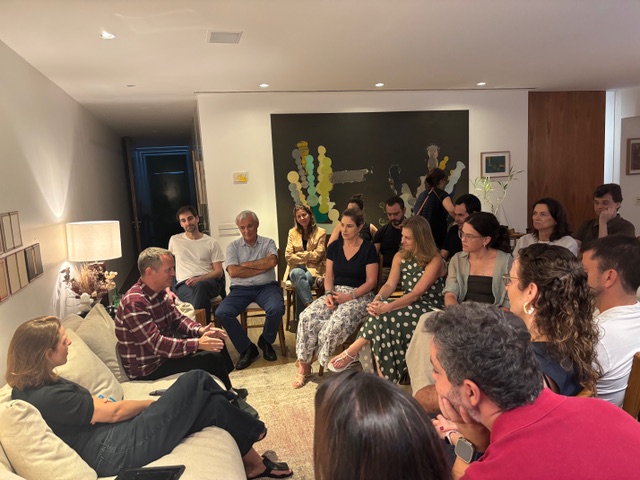
From March 9 to 16, Brazil played host to a series of workshops and public events led by the Head of the Irwin Cotler Institute for Democracy, Human Rights and Justice, Prof. Uriya Shavit. The workshops and events aimed to enhance understanding of antisemitism and the means to combat it effectively. Covering four key regions—Rio de Janeiro, Brasília, Goiás, and São Paulo—the initiative drew significant participation from judges, lawyers, police officers, security personnel, educators, law students, government representatives, diplomats and journalists, and was widely covered in the local media. Attendees were awarded the institute’s certificates of participation. Many shared their gratitude for the clarity and depth of the informative lectures and expressed their desire to visit Israel, and TAU’s campus, in the near future.
The visit was part of a broader effort to implement the IHRA definition, which has been adopted by 12 out of the 26 Brazilian federal states as of February 2024.
Prof. Shavit remarked: “The idea was to illustrate the historical mutations of anti-Jewish prejudice, and to clarify the difference between harsh criticism of Israel and antisemitism. I was pleased to meet the most gracious of hosts and to speak to attentive professionals that appear to have zero tolerance to any form of racism.”
The visit was initiated by Ruth Cohen-Dar, Head of the Department for Combatting Antisemitism and Holocaust Remembrance at the Israeli Foreign Office and superbly organized by Ambassador Daniel Zonshine, Deputy Ambassador Yonatan Gonen, Israel Consul in São Paulo Gili Vilian, Israel Consul in Brasilia Dror Yair, and Diplomatic Advisor Mireia Maia.
Igor Maier Pereira, Irwin Cotler Fellow for 2024-2025 and a native of Brazil, assisted in the preparation of the Portuguese-language version of the Quiz.
The first public event was held in Rio de Janeiro on March 9, and catered to education officials, teachers, and lecturers, with around 100 in attendance. Organized in collaboration with the education ministries of the Rio de Janeiro state government, the Rio de Janeiro municipality, and the judiciary, the session was also attended by representatives of Jewish organizations such as B’nai B’rith and the Holocaust Museum. Participants actively engaged in discussions, sharing their experiences as teachers and seeking guidance on identifying antisemitic incidents. Some noted that the session was timely, given the rising cases of hate crimes.
The same day, a workshop for more than one hundred members of the Civil Police, including high-ranking officials such as the head of the Civil Police and the chief of joint forces, was held. The senior officials underscored the importance of training security personnel in tackling antisemitic crimes, and highlighted that Rio de Janeiro was the first Brazilian city to adopt the IHRA definition. Officers from units tasked with investigating racially motivated crimes found the workshop particularly relevant and expressed interest in further training sessions.
After Rio, Prof. Shavit traveled to Brasília,the nation’s capital. There, Prof. Shavit led a workshop at an event hosted by the Brazilian Bar Association (OAB). Attended by more than 300, the audience comprised a diverse group of professionals, including members and representatives of counter-terrorism police units, racially-motivated crimes investigation units, human rights organizations, prosecutors, lawyers, law students, vice-rectors from leading Brazilian universities, the Brazilian Bar Association’s president and the education director of Brazil’s Ministry of Defense. Significantly, following the session, the district prosecutor’s office and the OAB decided to include a Jewish community representative in a working group focused on hate speech, an important step toward stronger legal and educational efforts against antisemitism.
The next stop was Goiás, the first Brazilian federal state to adopt the IHRA definition. The workshop led by Prof. Shavit there brought together judges, prosecutors, and high-ranking state government and security officials, including the state’s Deputy Governor and Minister of Public Security. Attended by approximately 100 participants, it focused on reinforcing the state of Goiás’s commitment to combating hate crimes and all forms of racism and discrimination.
After Goiás, Prof. Shavit travelled to São Paulo, where two key public events were held. The first, at the UNIBES Cultural Center in collaboration with StandWithUs, provided a platform for open dialogue between Prof. Shavit and attendees, who included academics, Jewish community members, and journalists. The interactive nature of the discussion was widely appreciated, fostering deeper understanding of antisemitism in contemporary society.
The second session, at Ibemc University in collaboration with StandWithUs, attracted municipal advisors, public figures, business leaders, and students of international relations. Officials from São Paulo’s Department of International Relations expressed their intention to integrate insights from the workshop into policy frameworks.
The evening before returning, Prof. Shavit was graciously hosted in the home of Marina Terepins and Mauricio Hazan for an event organized by Eduardo Wurzmann, the former president of the Brazilian Friends of Tel Aviv University and a member of TAU’s Board of Governors and Betina Hakim, the Executive Director of the Brazilian Friends of Tel Aviv University. There, Prof. Shavit discussed topics related to the origins of the Israeli-Palestinian conflict with more than 40 guests from various professional backgrounds, including law, medicine, and the arts.
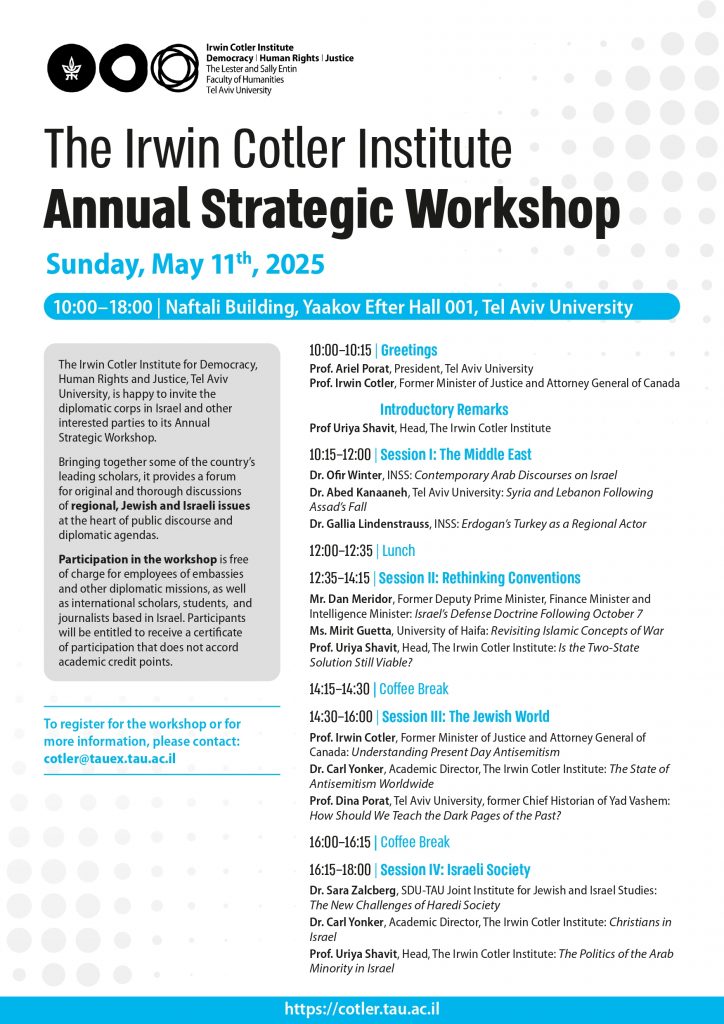
The Irwin Cotler Institute Annual Strategic Workshop
The Irwin Cotler Institute for Democracy, Human Rights and Justice, Tel Aviv University, is happy to invite the diplomatic corps in Israel and other interested parties to its Annual Strategic Workshop.
Bringing together some of the country’s leading scholars, it provides a forum for original and thorough discussions of regional, Jewish and Israeli issues at the heart of public discourse and diplomatic agendas.
Participation in the workshop is free of charge for employees of embassies and other diplomatic missions, as well as international scholars, students, and journalists based in Israel. Participants will be entitled to receive a certificate of participation that does not accord academic credit points.
To register for the workshop or for more information, please contact: cotler@tauex.tau.ac.il
Israel at War: Briefing Officials in Finland and Latvia
At the end of November, Prof. Uriya Shavit, the Head of the Institute, traveled to Riga, Latvia, and Helsinki, Finland, where he spoke to and briefed senior government officials and parliamentarians, members of local Jewish communities, and university students and professors on the current state of antisemitism and the Israel-Hamas War. He also conducted several interviews with the local press in each country. The trip was organized by the Israel Foreign Ministry, the Embassy of Israel in Latvia and the Embassy of Israel in Finland.
In his talks at the Latvian parliament, the Janis Lipke Museum, and the University of Latvia, Prof. Shavit spoke about Hamas, its hateful ideology, and what Israel must do to defeat it, as well as addressed whether criticism of Israel is antisemitic and discussed the links between criticism of Israel and the rise in antisemitism in times of conflict. In his briefings in Finland to members of parliament – including the Chair of the Foreign Affairs Committee, Mr. Kimmo Kiljunen – and the local Jewish community, Prof. Shavit spoke about the current state of antisemitism, incidents of which spiked considerably following Hamas’ October 7 attack. He also provided a strategic overview of the war and other threats Israel is currently confronting.
Israel at War
The Irwin Cotler Institute, in cooperation with the Center for the Study of Contemporary European Jewry, has held three seminars on Israel at war. They can be viewed here:
Israel at War (1)
Strategic Perspectives and Practical Tools in Fight for International Public Opinion
Prof. Uriya Shavit, Tel Aviv University: Hamas – What they Want and Why They Endanger Civilization
Gen. (Ret). Danny Yatom, Former Head of the Mossad: Israel at War – A Strategic Perspective
Dr. Carl Yonker, Tel Aviv University: Using Social Media to Help Fight Evil
Q & A with the audience
Israel at War (2)
Fighting 21st-Century Nazism
Prof. Uriya Shavit, Tel Aviv University: The War – Social and Political Implications
Gen. (retired) Danny Yatom, Former Head of the Mossad: The War So Far – A Strategic Perspective
Dr. Carl Yonker, Tel Aviv University: The Ideology and Strategic Ambitions of Hizballah
Israel at War (3)
Noah Abrahams, Former BBC Journalist: Why I Resigned from the BBC
Dr. Hay Eytan Yanarocak, MDC-Tel Aviv University & JISS: Turkey, Hamas, and the War against Israel
Shiven Nath, Former Irwin Cotler Institute Fellow, Tel Aviv University: India – Official and Public Opinion on the War
Dr. Carl Yonker, Tel Aviv University: The American Radical Right and the War
Q & A
Israel at War: The Challenges for Jewish Communities
Opening Words
Prof. Youval Rotman, Tel Aviv University
The Challenges for Jewish Communities: Introductory Remarks
Prof. Uriya Shavit, Tel Aviv University
Speakers
Dr. Mia Spiro, University of Glasgow
Prof. Arieh Dubnov, George Washington University
Dr. Aleksandra Gliszczyńska-Grabias, Polish Academy of Sciences
Mr. Ronen Bahar, Head, Jewish Community of Oslo
International Workshops on Antisemitism and Racism
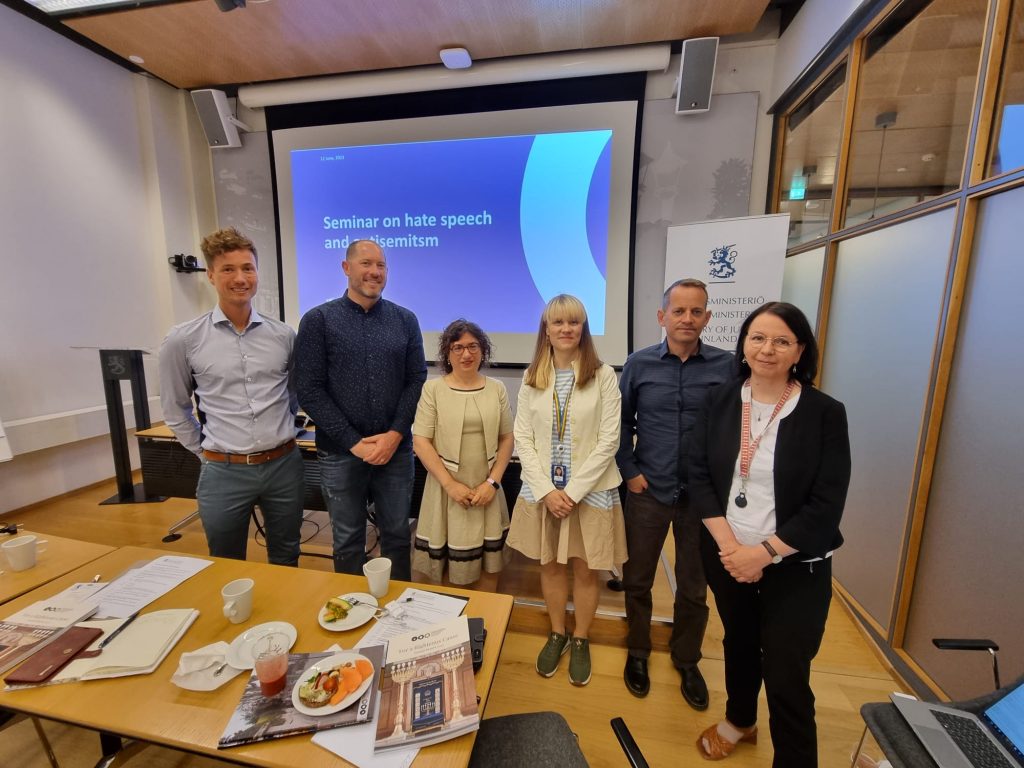
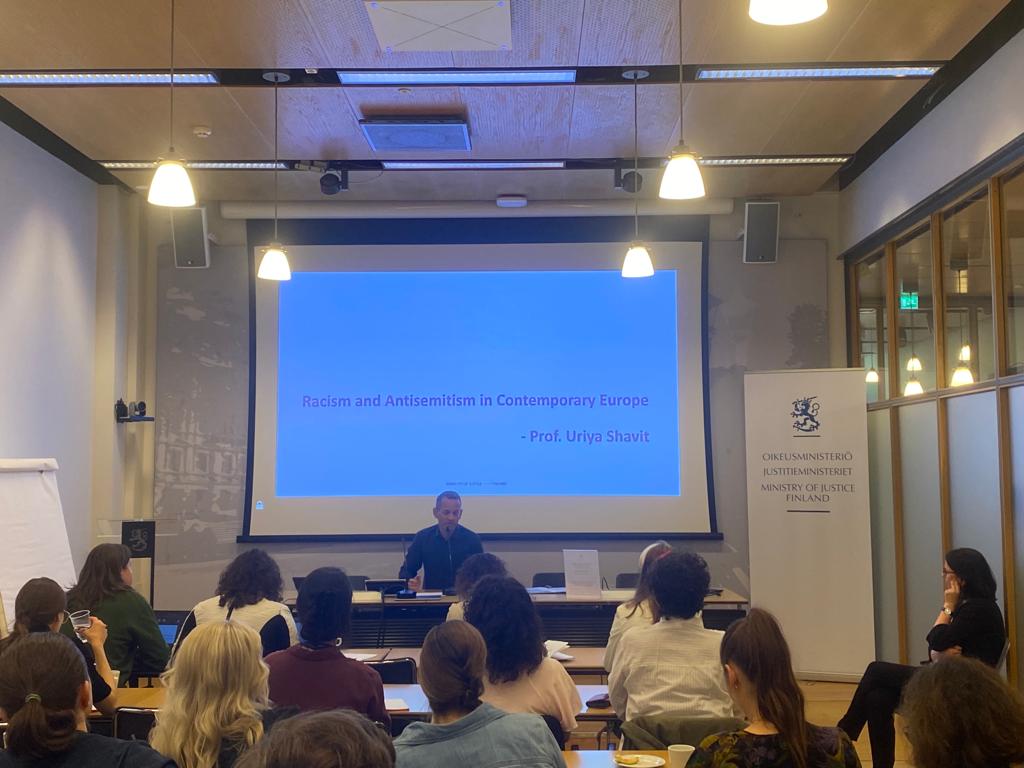
In June 2023, the Institute led one-day seminar in Finland for public officials, law enforcers, diplomats and other officials on hate speech, racism, and antisemitism in Europe and the world and the means to fight them. The seminar was initiated and organized together with the Embassy of Israel in Finland and with Finland’s Ministry of Justice.
The seminar was attended by more than 80 senior officials from various Finnish government bodies including, among others: the Justice Ministry; the Central Finland Police Department; the Embassies of Finland in Budapest and in Vilnius; the Ministry of Foreign Affairs; the Helsinki Police Department; the Ministry of Interior; the National Bureau of Investigation, and the Prime Minister’s Office.
Prof. Uriya Shavit, the Head of the Institute, lectured on racism and antisemitism in contemporary Europe, while Dr. Carl Yonker, the Institute’s Academic Director, spoke on online radicalization and the means of countering it, and Dr. Fabian Spengler addressed violent and racist sports fans, offering policy proposals for countering racism in stadiums. An additional lecture focusing on the history of antisemitism in Finland was given by University of Helsinki scholar Dr. Paavo Ahonen.
In the opening ceremony in Helsinki, Israel’s Ambassador to Finland and Estonia, H.E Hagit Ben-Yaakov, noted the importance of learning to identify antisemitism, raising awareness about racism in general, and prosecuting antisemitic criminal acts. She mentioned an incident in which a sticker with a Nazi symbol was placed on the embassy gate in Helsinki and the subsequent investigation that did not result in an arrest or prosecution. The Finnish Ministry of Justice’s Head of Department, Ms. Johanna Suurpää, emphasized racism and discrimination must be dealt with effectively.
The timing of the seminar and the topics it covered, ironically, were perfect. Just a week after the seminar, Finland’s economy minister and member of the right-wing populist Finns Party, Vilhelm Junnila, was forced to resign over comments about Nazism and his connection to a far-right event linked to neo-Nazis. He had only been in office for ten days and the swift response – removing a minister from the country’s second largest party – should be applauded.
In conversation with Ms. Suurpää, and Ms. Mia Luhtassari, Senior Specialist at the Ministry of Justice, following the seminar, both commented on the challenges faced by the Ministry and law enforcement in countering online radicalization and prosecuting hate crimes. Ms. Suurpää stated that while there was better cooperation between governments and tech companies, there remains much work to be done to close existing gaps.
Riga
In Latvia, the Institute and the Israeli Embassy in cooperation with the Latvian Police held a one-day seminar similar to the one held in Helsinki for ranking law enforcers in Riga, including investigators, unit heads, and patrol officers. Topics covered included antisemitism, racism, the far-right in Europe, online radicalization, and racism among fan-support groups for sports teams.
Sofia
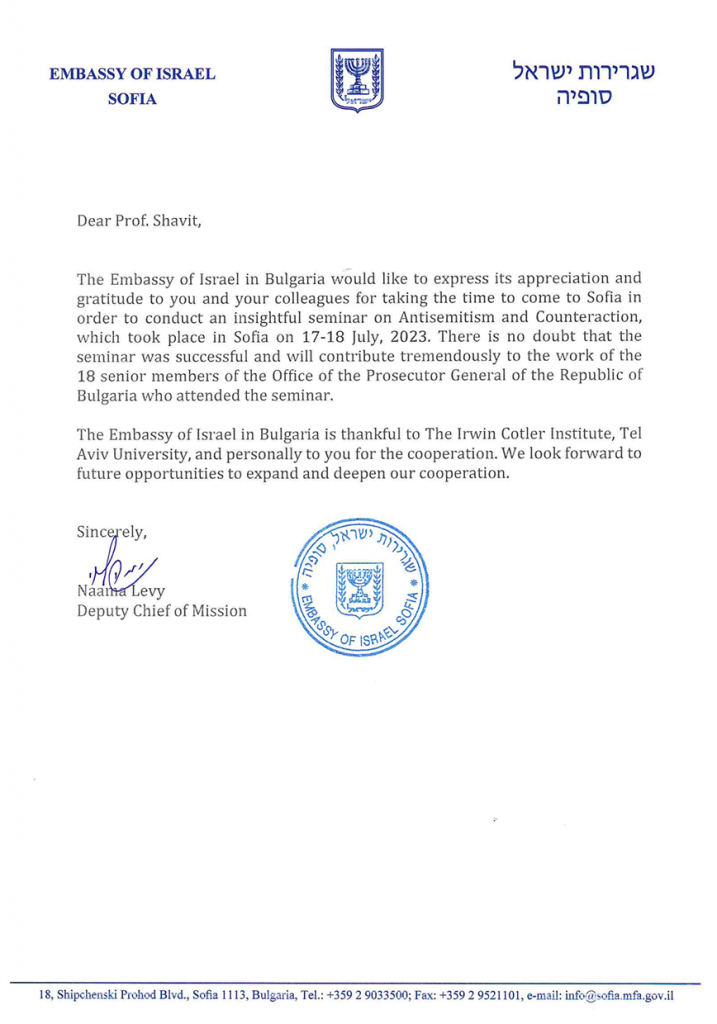
In July 2023, the Institute led a two-day seminar in Bulgaria for 20 public prosecutors and investigators with Bulgaria’s Ministry of Justice on hate speech, racism, antisemitism, online misinformation, and the means to fight them. The seminar was initiated and organized together with the Embassy of Israel in Bulgaria and with Bulgaria’s Ministry of Justice.
Prof. Uriya Shavit, the Head of the Institute, lectured on racism, the roots of contemporary antisemitism and the history of early Zionism, while Dr. Carl Yonker, the Institute’s Academic Director, spoke on the state of contemporary antisemitism and the radical right in Europe and the United States. In addition, Mr. Eran Vasker lectured on online antisemitism and hate speech and the means to monitor them, and Mr. Moses Toshimasu spoke about Japan as a case study that demonstrates that antisemitism does not require Jews or involvement in the Arab-Israeli conflict to exist.
Seminar: The Rise and Fall of Big Ideas
Why do some political ideologies that gain great public traction fade at one point, as if they never existed, while others continue to thrive despite their failures?
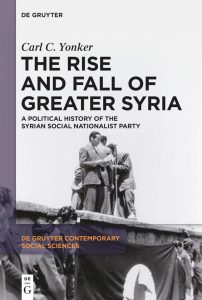
The publication of the book The Rise and Fall of Greater Syria (De Gruyter), authored by the Institute’s Academic Director, Dr. Carl Yonker, provided an opportunity to explore this question during a Zoom seminar on June 1, 2023. The book traces the misfortune of the Syrian Socialist Nationalist Party, a fascist pan-Syrian movement that for a moment seemed to have a real chance of dominating Syrian and Lebanese politics, and then was all but extinguished. Bringing together social scientists and scholars of intellectual history, the seminar will explore comparatively the dynamics that make certain ideologies long-lasting and others – not, in the Middle East and beyond it.
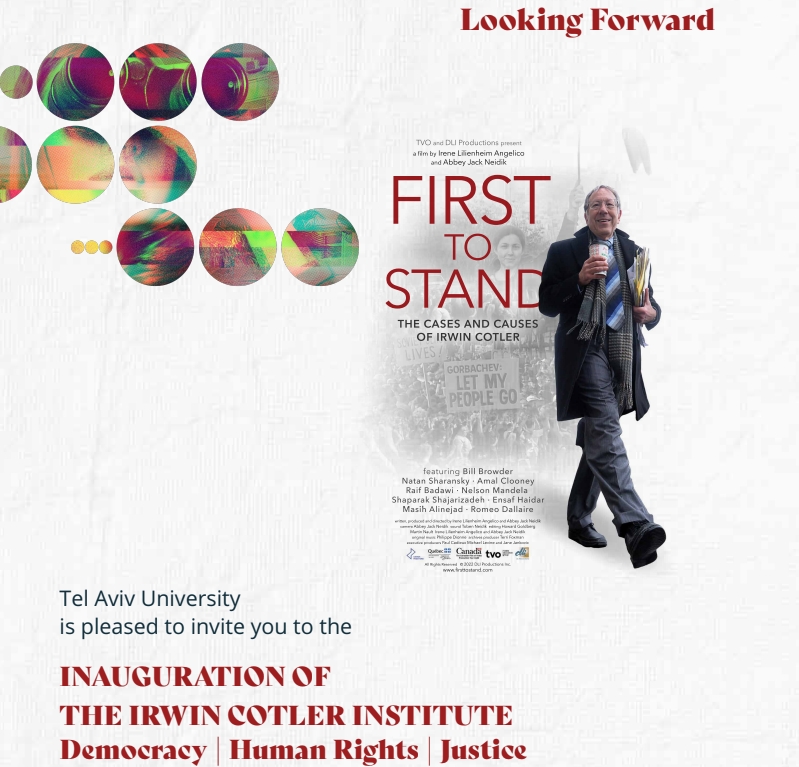
Inauguration Ceremony
On May 14, 2023, 17:00, exactly 75 years to Israel’s independence, the Cotler Institute for Democracy, Human Rights and Justice was inaugurated in an official ceremony at the Senate’s Conference Hall at Tel Aviv University (TAU).
Celebrating and advancing the legacy of one of the greatest and most respected jurists and advocates of justice and human rights in our time, the Institute provides a unique space for scholars and students from different disciplines who share a passion for advancing freedom and fighting bigotry as well as seek to learn more about the history of Israel and its diversity.
The ceremony was attended by Irwin Cotler, his wife Ariela and their extended family, the President of TAU, Prof. Ariel Porat, Canada’s Ambassador to Israel, Lisa Stadelbauer, and dozens of other distinguished guests.
Cotler Institute Participates in Workshop on Identity and Resilience in Florence
On February 3-4, the Cotler Institute joined TAU’s International Office and its Lowy International School in organizing the workshop “Facing Antisemitism, Building Resilience” in Florence, Italy, attended by dozens of members of Jewish communities in Italy as well as academic scholars and young pro-Israel Italian activists.
A vocal pro-Hamas rally in front of the building where the workshop was held forced much police attention but failed to affect the good order and success of the workshop.
Prof. Uriya Shavit, Head of the Cotler Institute, gave three lectures: on the rise of antisemitism and the means to fight it; Jewish identity in the 21st century; and the current situation of the war in Gaza.
MKs, Police, Scholars and Community activists engage in Dialogue on Over-Policing among Ethiopian Jews
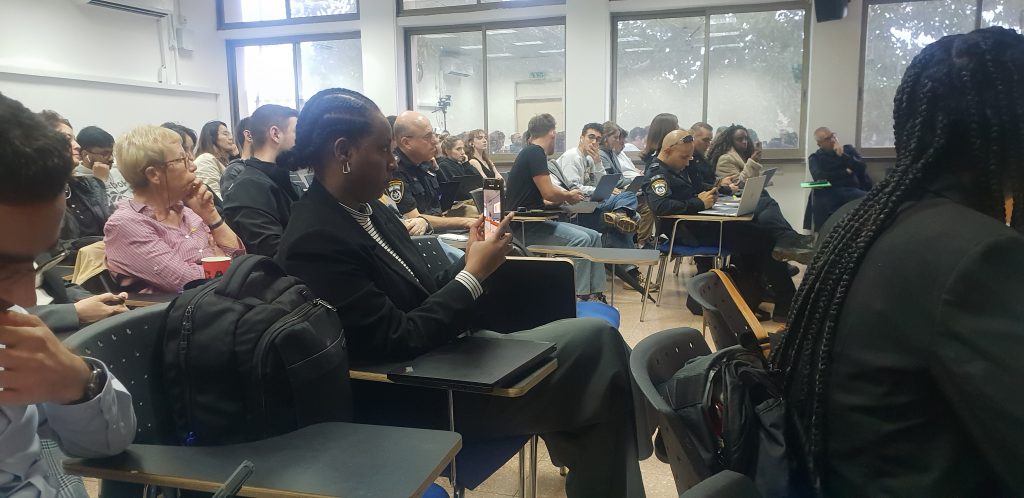
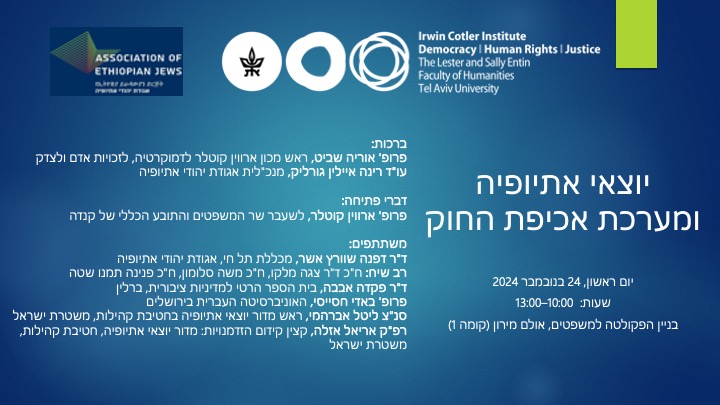
On November 24, 2024, the Irwin Cotler Institute, in cooperation with the Association of Ethiopian Jews (AEJ), hosted a conference on the Ethiopian Jewish community and the justice system in Israel. The conference, taking place at a packed-to-the-brim lecture hall at TAU’s Law Faculty, brought together dozens of lawyers, community activists, students, Irwin Cotler Fellows, professors of criminology, high-ranking officers from the Israeli Police, and members of Knesset to address and to discuss the issue of over-policing.
Prof. Irwin Cotler, Canada’s former Minister of Justice and Attorney General, noted in his opening remarks the timeliness and importance of discussing the issue and his pleasure with the Cotler Institute partnering with the AEJ. Prof. Cotler stressed that over policing is not a phenomenon peculiar to a democracy like Israel, but in Israel it takes on a poignant dimension because it reflects the ongoing experience of Ethiopian Jews and their struggle for equality before the law. Moreover, the test of a just society is how it treats the most vulnerable amongst it.
Prof. Uriya Shavit, Head of the Cotler Institute, and Adv. Rina Ayalin-Gorelik, the AEJ’s Executive Director, offered welcoming remarks. Prof. Shavit noted the importance of dialogue between police and communities in addressing the issue of over-policing and of being informed by comparative academic studies on the matter. Adv. Ayalin-Gorelik noted the painful reality the data in a special report compiled recently by her organization regarding over-policing reveal, and stressed that the struggle for justice and equality before the law is not for the rights of one community alone, but is rather for the rights of all Israelis. She noted that discriminatory treatment by law enforcement harms Ethiopian Jews’ sense of belonging and trust in law enforcement, while criminal records for minor offenses threaten the future opportunities for Ethiopian Jewish youth.
Presenting the AEJ’s special recent report on over-policing, Dr. Daphna Schwartz Asher of the AEJ and Tel Hai College observed that the share of cases opened against Ethiopian Jews of all ages exceeded the proportion of the Ethiopian Jews in the Israeli population (2%). Between 2022 and 2023, the share of cases opened against Ethiopian Jews for assaulting a police officer rose from 4.24% to 5.16% of the overall number of cases nationwide, while the share of cases opened for obstructing a police officer rose from 4.06% to 4.23%.
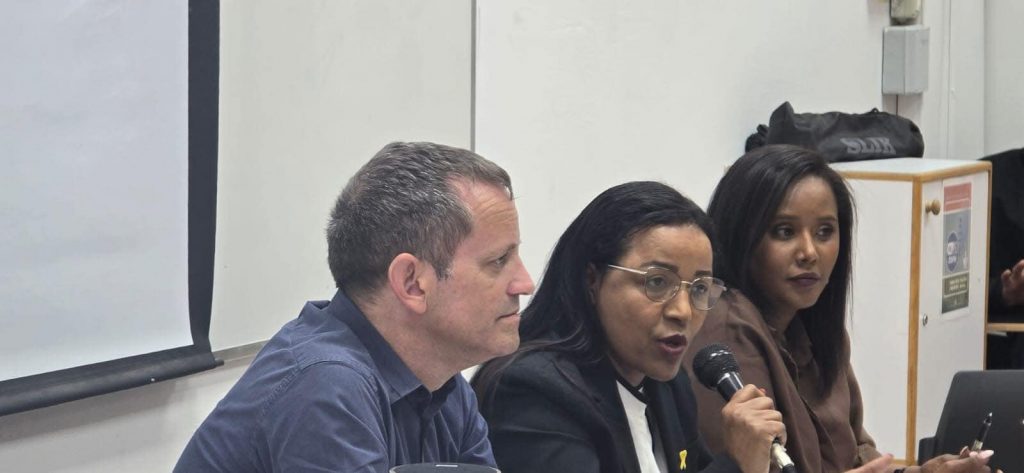
Following Dr. Asher’s presentation, Prof. Shavit chaired a roundtable discussion with two members of Knesset, MK Dr. Tsega Melaku (Likud, in government) and MK Pnina Tamano-Shata (National Unity, in opposition). MK Melaku and MK Tamano-Shata spoke on the recently enacted law in the Knesset to expunge the criminal records of Ethiopian Jews convicted of minor offenses, particularly the broadly-defined offense of “disturbing the public order.” Both also shared their painful personal experiences as mothers of children who have experienced racism and over-policing, and voiced their frustration at what they believe to be the Israeli police’s slowness in changing its interaction with the community and to build trust. They stressed their hope and desire for improvement and belief that advancing the rights of the Ethiopian Jewish community will also positively impact other minority communities in Israel such as Arab Israelis and the ultra-Orthodox.
Following the panel discussion, Dr. Fekade Abebe of the Herti School for Public Diplomacy in Berlin and Prof. Badi Hasisi of the Hebrew University in Jerusalem provided academic perspectives.
Dr. Abebe observed that the topic of over-policing has been addressed in conferences and in other forums over the years and that while there may be broad agreement and goodwill to treat the issue and repair relations between the community and law enforcement, it remains unresolved. The core problem is how the police interact with citizens, particularly minorities. This problem results from several factors, including the inherent and historical connection between the police and the military in Israel; the roles of each are distinct and different, but blurred in the Israel police, leading it to act with too heavy a hand against citizens.
Prof. Hasisi, a criminologist specializing in minority-police relations and profiling, spoke on the importance of data analysis regarding age and gender. Through nuanced analysis, he argued, one can appreciate whether the problem of over-policing impacts a particular segment of a minority population. Prof. Hasisi noted that the AEJ special recent report contains findings that are both negative and positive. One of the most positive trends is the decline in arrests among young Ethiopian Jews. He concluded his presentation with practical advice to the police, including on how to conduct in-person communication with citizens in ways that discharge tensions and build trust and understanding. The advice stirred much interest among the police officers present.
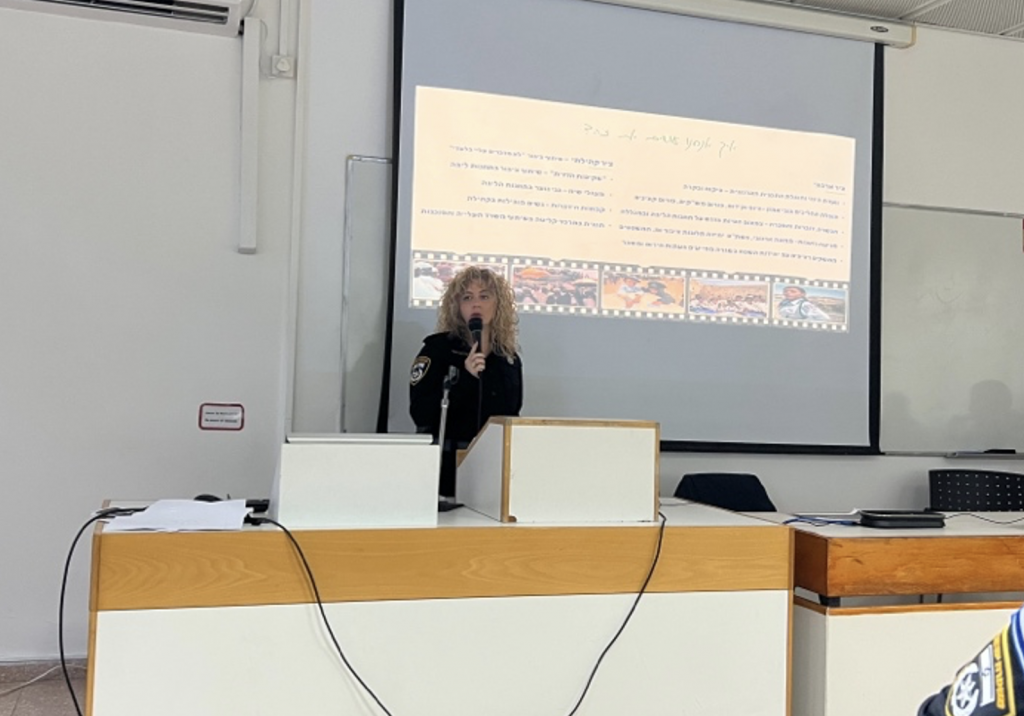
The conference ended with presentations from members of the Israel Police, that was represented by five high-ranking officers. Chief Superintendent Lital Avrahami, head of the department responsible for fostering relations with the Ethiopian Jewish community, acknowledged that significant work remains to be done but noted that when looking at the statistics from the past five years, there are positive trends to build upon, including declines in the number of arrests and cases opened against Ethiopian Jewish youths and minors between 2019 and 2023.