
Interview: Ordinary Men. And Worse
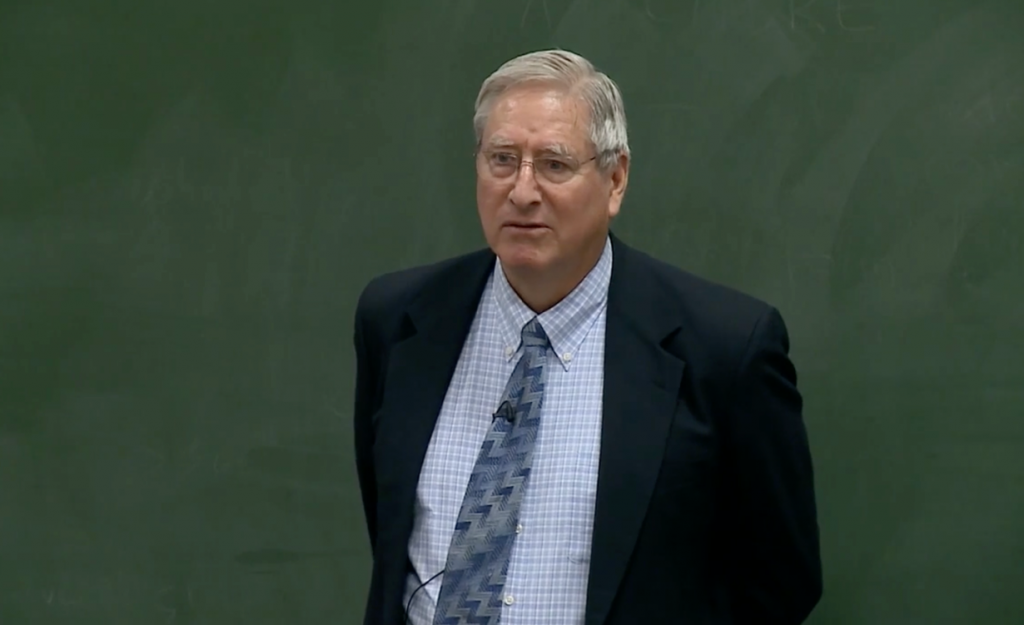
Professor (emeritus) Christopher Browning is the leading living expert on the Nazi Final Solution and a member of the American Academy of Arts and Sciences since 2006. Born in Durham, North Carolina (1944) and raised in Chicago, Browning completed his PhD at the University of Wisconsin-Madison and taught for most of his career at Pacific Lutheran University, Washington, and the University of North Carolina at Chapel Hill.
In 1992, Browning published a groundbreaking and controversial book, Ordinary Men: Reserve Police Battalion 101 and the Final Solution in Poland. Based on analysis of the interrogations of members of a police battalion who took part in the cold-blooded terrorizing and murder of thousands of Polish Jews, Browning argued that the majority of them were not necessarily motivated by deep-seated antisemitism, nor by fear of being severely punished by their commanders. Rather, they committed their horrifying crimes because of obedience to authority, fear of being labeled as cowards, and the gradual normalization of terror.
In 1996, another American scholar of the Holocaust, Daniel Jonah Goldhagen, authored a rebuke of Browning in his book Hitler’s Willing Executioners: Ordinary Germans and the Holocaust. Goldhagen argued that German antisemitism developed unique eliminationist ambitions that were ingrained in society and were what made the Holocaust possible. The debate between the approaches has become central in the contemporary study of the Holocaust and the study of the human capacity to commit evil at large.
Browning is a relentless voice in the fight against Holocaust denial and distortion. In 1996, he served as a key witness in the failed libel lawsuit filed by David Irving against Prof. Deborah Lipstadt. In her book Denying the Holocaust (1993), Lipstadt accused Irving of deliberately distorting historical evidence and described him as a particularly dangerous Holocaust denier. Browning testified that there could be no doubt that Hitler let his subordinates know his wishes regarding the fate of European Jewry.
Prof. Uriya Shavit, Editor-in-Chief of the Report and Head of the Center for the Study of Contemporary European Jewry and the Irwin Cotler Institute for Human Rights, Democracy and Justice, recently discussed with Prof. Browning the state of Holocaust Studies in the West and the reemergence of antisemitism in America. The conversation was edited for clarity and length.
Prof. Shavit: Why has antisemitism resurged in American political discourse?
Prof. Browning: Well, I think two things have happened. One is a conjunction of factors on the right, that American politics has a right-wing movement that’s become much more authoritarian, much more racist, much more conspiracy theory-oriented. Historically, when you mix conspiracy theory, racism, and authoritarianism, you almost always get to antisemitism.
There is a shift rightward in American politics, a shift towards a less democratic stance, a devaluation of the focus on human rights, human equality, and human dignity. We have a president who openly ridicules people, talks cruelly, and sets a model for how to abuse people. If you combine that with racism, even if he himself does not make antisemitic statements, it opens the door and permits all sorts of other people to take that one last step.
At the same time, we now have developments on the left that have also contributed to more antisemitism. I am 82. You know, when I grew up, Israel was David, and the surrounding world was Goliath. Israel was struggling to survive, and it was a democracy committed to human rights and shared values.
The current generation in America knows nothing but Netanyahu. Their view of Israel is from the year 2000 on, from the Second Intifada on. What they see in the Israeli prime minister is a man who interferes in American politics, sides with and campaigns for the Republican Party, and puts his hand on the scale of American politics. A prime minister who is carrying out much of the same program as Trump, who is attempting to capture the judiciary.
Prof. Shavit: The Christian nationalist version of antisemitism is, in a way, more intriguing because if you are one of them, there is so much else to hate, and yet they are still in need of Jews as a focal point of hatred.
Prof. Browning: That’s kind of strange because on the evangelical side, they’re very pro-Israel, even if it’s because of the Bible, you know, their New Testament basically says: “You have to have the refounding of the Jewish state, which then will face the apocalypse, announcing the new age.” You know, Jews, from the evangelical point of view, Jews are kind of like the bourgeoisie for Marx. They are necessary in the progression of history, but then they have to disappear. So, you have the evangelicals, who are very pro-Israel. And then, on the other hand, you have the Christian nationalists, who are racist enough.
But, you know, I don’t see antisemitism as their focal point. Their main focal point is the replacement theory, the notion that America is going to be overwhelmed by immigrants of color. Some of them argue that this conspiracy is led by international Jewry, yet on the other hand, they also admire ethnic nationalist Jews. They hold, in a sense, that Netanyahu and Israel represent how the rest of the world should act. They propagate the notion that George Soros and the wrong kind of Jews are masterminding the invasion that would lead to replacement, yet this conspiracy theory is a step away from total racist antisemitism, as it judges Jews on behavior as opposed to blood. Jews can behave well to earn an entry… It is a very complex thing.
Prof. Shavit: In composing the conspiracy theory of the replacement, they didn’t have to choose George Soros.
Prof. Browning: He is the most preeminent visible symbol. I mean, if you have a name that comes up the most often as an example, it is George Soros.
Prof. Shavit: Who just happens to be a Jew. So, that’s basically my question. He just happens to be a Jew, or is it that he was chosen because he is Jewish?
Prof. Browning: Well, he represents sort of the general values of international liberalism, of which Jews have been a part. And so he became a convenient symbol.
Prof. Shavit: Is there any point in fighting those people and in denouncing them and disproving them, whether on the left or on the right? I am going back to your testimony in the David Irving trial. I mean, there’s always the risk that when you strike back against Holocaust deniers, you just amplify the conspiracy.
Prof. Browning: Yes, that’s the dilemma. The conspiracy theorists are looking for publicity. They’re looking for attention. And so, the question is, do you ignore them or do you engage them? I would say you engage, but not with them, but about them. That is, I would never go and debate David Irving, giving him the status of equality on the stage and recognizing him as a debating partner.
But in a courtroom, where you have rules of evidence, and you have a judge, and they can’t keep shifting the goalposts, then I think that’s a way in which I would engage them.
Prof. Shavit: There isn’t really a way to refute a conspiracy theory, is there?
Prof. Browning: You can expose it, but you cannot, I mean, you cannot persuade the conspiracy theorists because they always have a new fallback position, and they’re not living in the same reality as the one you are living in. I mean, that’s a part of the whole problem of American politics right now, that we have two realities. We have a reality and an alternate reality. And we cannot find any common ground upon which to debate because one side simply says that there is no such thing as facts.
Prof. Shavit: Now, what I am going to say is not very popular in my country, but I’ll say it anyway. As a Jew and a student of history, when I hear Donald Trump, it is not so much the words that alarm me; it’s the music. Because I know that Jews have had better and worse times when living in democracies, but it was fascism that sought their annihilation, and almost succeeded.
Prof. Browning: That’s what I was trying to say earlier. In a sense, Trump’s behavior gives permission for people to engage in antisemitic rhetoric even if he doesn’t become a spokesman for antisemitism himself. He nonetheless creates a permission structure of how you talk about others and how you talk about minorities. How you don’t have to be inhibited, or, in fact, that it is a badge of honor to be politically incorrect and to trash immigrants, trash different groups.
Ultimately, Jews are one of the minorities. I mean, if you can trash Haitians and trash Somalis, eventually you’ll get to attacking Jews as well. Trump allows people to freely express their prejudices with absolutely no criticism, no restraint, no inhibition.
Prof. Shavit: Would you support stronger restrictions on social media? The United States has a unique problem. It’s called the First Amendment. America has become a safe haven for racists, the worst of the worst. And I don’t think that was the intention of the Framers of the Constitution.
Prof. Browning: Yes, I mean, everybody has the right to speak, except for the limits of inciting actual violence or yelling fire in a crowded theater, or defamation. The problem is with media that are classified legally as a neutral platform, a bulletin board on which people pin up their various views. Which that media are not. I mean, newspapers don’t enjoy that privilege [to be considered a neutral platform with no responsibility for content]. Newspapers are responsible and could be sued for libel when they publish, you know, false things.
And so, my feeling is that American law has to be changed in a way that social media have to exercise some self-policing or become liable for defamation or liable for damages when they harm people. That doesn’t curb freedom of speech. We have those restrictions on speech already.
Prof. Shavit: Algorithms are a form of editing. That’s what people sometimes don’t realize about social media: there is an editor out there, but one that bears no responsibility, unlike the case of newspapers or television channels.
Prof. Browning: Yes, exactly, these platforms are not neutral. They are making a profit by giving people the opportunity to take advantage of their services. And, in fact, the owners abuse the platforms themselves, as you say, with the design of their algorithms. So, I think what needs to be done is a change in the laws that regulate their status to make them more like newspapers and less like bulletin boards.
Prof. Shavit: I read your piece in the New York Review of Books on Trump and his administration’s fight against antisemitism on campuses. Very convincing. But could this be a case of two wrongs that make a right? That is, his motivations might be cynical, but the result is that universities in the United States are today more conscious about the need to apply certain standards to protect Jewish students.
Prof. Browning: Well, I hesitate because the way in which they’ve gone about it is so damaging.
I taught for 25 years at Pacific Lutheran University before I moved to North Carolina. Back in 1975, my course was one of the very first courses in the United States that taught about the Holocaust. The school, by now, has developed a major program in Holocaust studies. For a small college, it is probably the best in the entire country.
Nonetheless, some time ago, there was someone who took this course online, not even on campus, who did not like a comment that some other student made, and filed a complaint with the Department of Education. As a result, Pacific Lutheran University was one of the universities that got a letter [from the Trump Department of Education’s Office of Civil Rights (OCR) about potential enforcement actions if Jewish students were not protected under Title VI. The OCR letter was sent in March 2025 to 60 universities, including Pacific Lutheran].
Prof. Shavit: What was the comment that caused the rage about? Was it indeed antisemitic?
Prof. Browning: I don’t even know what the comment was. I mean, I just heard that the student had objected to what somebody else had said.
Prof. Shavit: But it wasn’t something you would interpret as blunt antisemitism?
Prof. Browning: I don’t know what was said. But you know, when you get that kind of situation, and it used to bully a university, the damage that can be done is so much greater than what the threat was.
Now, clearly, there are some places where we have seen more overt antisemitism, and that does need to be dealt with. Universities have, in a sense, a triple responsibility. One is to preserve freedom of speech, another is to preserve academic freedom, and yet another is to preserve an atmosphere of civility in which students are not harassed, not intimidated, not threatened, and are free to exercise their right of free speech.
Obviously, at some point, what one side perceives as legitimate academic freedom and free speech, another side is going to perceive as threatening. There just isn’t an easy litmus test where it turns out, you know, pink or blue, where there’s a rubbing point. And that’s a part of university life. You don’t go to a university with a guarantee of being comfortable; anytime, you may be in an atmosphere where there is an intellectual challenge. You can’t remove every source of discomfort that a student may face. That’s what many parents now [seem to desire for their children] and what many students [want].
Prof. Shavit: From my experience here, some American students think that if they say the magic words, “I feel unsafe,” then everyone shall salute and cave to whatever they feel unsafe about, including debates or statements that are perfectly legitimate.
Prof. Browning: Well, a give-and-take in Israel would frighten most Americans. That’s true. The intensity of political discussion in your country is so much more than what most Americans are used to.
Prof. Shavit: There is so much study of the Holocaust today, and so much antisemitism. That makes one think about what the study of the Holocaust achieved, no?
Prof. Browning: I think we have to get away from the notion that if we teach the Holocaust or we take somebody to a Holocaust museum, this is going to be like a vaccination. That it’s going to make the person immune to antisemitism. Well, it doesn’t.
I think that what we do educationally is much better than if we did nothing. But we shouldn’t have the naive view that if we’re out there teaching, then the world will be safe from prejudice.
It’s important in the same sense as when I’m dealing with American politics. There’s a middle group that you have to get to. There’s a large group out there on the other side that’s unreachable. The one that has to be gotten to is that middle group that is persuadable, and it helps if they have a historical perspective. It helps that they learn things they wouldn’t know if I didn’t teach a course or if I didn’t write an essay. It’s my way of trying to contribute. But I don’t have the notion that it’s a perfect and complete answer because there is no perfect and complete answer.
Prof. Shavit: Last year, I had a discussion for our For a Righteous Cause Report with Sir Max Hastings, a historian of the Second World War. He said he felt there was too much teaching of the Holocaust in European schools, that today all that young people know about the Second World War is that there was a Holocaust. Do you sympathize with that?
Prof. Browning: Of course, that’s very ironic, because up to the late 1970s, I could take a history course at any university in the United States, and no one ever mentioned the Holocaust. Back in the 1960s, I took a whole course on German history, and we spent one day on “the SS state,” but even that lecture did not focus on the Holocaust.
You can look at any American textbooks from the 1950s and 1960s, and maybe you get one line: “and then indescribable things happened,” after which they move on to something else.
So, I don’t share the sentiment of Max Hastings. We’ve got lots of courses on the Second World War. I taught a course on Europe and the World Wars before I retired, alongside the course I taught on the Holocaust. I did both. There’s no zero-sum game. We all need more teaching of history everywhere. But I don’t think we’re ignoring other areas because we’re teaching too much about the Holocaust. I urge that we put more effort into getting more history elsewhere, rather than blame the Holocaust for not having enough history classes.
Prof. Shavit: Well, perhaps there is a difference between the UK and the US in terms of the scope of teaching history. Although I doubt that.
There was one more thing Sir Hastings said, which is, I think, still very much relevant today: Europe is not taking its defense seriously enough. This should have been one of the lessons of the Second World War. That you need to have the military strength to face aggression. And that is not the case in Europe. It still isn’t. I think it was someone in Poland who said it doesn’t make a lot of sense for 400 million Europeans to have 300 million Americans defend them from 150 million Russians.
Prof. Browning: I would say several things to that. One, of course, when Europe was in ruins after the Second World War, America wanted very much for Europe to rebuild and gain economic and political stability so that the communist parties would not have appeal in Italy or France, or elsewhere. So we were anxious they don’t spend too much on their militaries. And then, of course, after the end of the Cold War in 1989, it didn’t seem terribly urgent for European countries to arm. Governments respond to situations as they change. It didn’t make a lot of sense to have spent oodles of money on the military in the 1990s.
Prof. Shavit: Shouldn’t the response to the aggression of fascist Russia have been the reintroduction of conscription in Germany, in France, in the United Kingdom, not to mention smaller and more vulnerable European nations?
Prof. Browning: I mean, obviously, once Putin was on the march, people should have been getting ready, and I think they belatedly were. But I don’t think we should have foreseen that in the 1990s.
Prof. Shavit: It’s more than four years since the Russian aggression began. It is as if Europeans insist on not understanding that democracies have to be strong enough to defend themselves by themselves. They have to be able to stand up against bullies and against those who are worse than bullies.
Prof. Browning: Yes, but the European countries have been increasing their defense budgets.
Prof. Shavit: The budgets, yes, but they have not really changed their mentality. Buying a bit more arms, better defense systems, that’s nice, but European democracies need way more soldiers, and they just don’t have them yet, and I don’t see them going in this direction, not really.
Prof. Browning: Not at the moment. You know, Trump complains about Europe having a free ride on the US military, but it’s Trump who’s insisting the Europeans buy weapons from the US to give them to the Ukrainians. Americans are making gun profits.
Prof. Shavit: We had an interview with Senator Joseph Lieberman just before he died. He said something that sounded to me rather tragic. He said that in the 2000 presidential campaign, he learned that America could accept a Jewish vice president, which meant it could potentially accept a Jewish president. Two years ago, he wasn’t that certain that this was still the case.
Do you think the United States is now ready to have a Jewish president?
Prof. Browning: It will have to be a right-wing Republican because any Democrat running as a Jew, or running as a woman, or running as a black woman will not get elected. I mean, if you look around, for example, where women got elected for the first time, you know, Angela Merkel, Indira Gandhi, the breakthrough was always by a woman on the right.
Prof. Shavit: Are you generally optimistic about the United States?
Prof. Browning: No, I think very severe damage has been done to American democracy in terms of democratic norms. And I think at the same time, so far, at least certain trenches of democracy have not been overcome by Trump.
I mean, the state governments that are blue have remained. A second is that we still have elections. The playing field is not even, but Trump still has to contend with an opposition party.
I think there’s not going to be a total dictatorship in America. But Trump is going to damage the fabric and the norms of democracy.
Prof. Shavit: I don’t know if that’s even possible to answer, but do you have a recollection of what made you decide to dedicate your life to the study of Nazism and specifically the Final Solution? You are not Jewish, and the Holocaust was not family history for you.
Prof. Browning: Oh, yes, very specifically.
I wrote my master’s thesis on French history and French diplomatic history. This was the period of the Vietnam War. After my first year in graduate school, I had to leave school. Mine was the first year in which they would not give graduate school deferments [for service in Vietnam]. However, they did give teaching deferments. So I taught for three years.
At the school where I was teaching, there were many introductory courses on Western history. I was told there is a course in German history in the catalog that nobody has taught for a long time, and I was asked to teach it. And I agreed.
Then I wrote to a number of different people, former professors, asking them, you know, to offer me guidance. What should I read? What should I assign?
One of them wrote back and recommended Hannah Arendt’s Eichmann in Jerusalem as a good book for a class discussion. Well, I hadn’t read it at the time. I had, in fact, read parts of Hannah Arendt’s Origins of Totalitarianism. But not her book on Eichmann.
I was fascinated by it. But I didn’t know the wider context. You know, what were other people saying about the Judenrat? What were other people saying about the Eichmann trial? That was my first exposure to the history of the Holocaust.
Arendt’s book mentioned Raul Hilberg. And so I ordered his book, The Destruction of the European Jews. It turned out to be the 1961 edition, the first edition, which was 850 pages and contained thousands of footnotes. And, you know, here I was getting to prepare my first college lectures on everything from the pyramids to the American presidency. How would I possibly use this book?
I literally threw it on the table next to my bed. Then, after some time, I got very sick and was bedridden. When I felt well enough to read, The Destruction of the European Jews was the book I could reach without getting out of bed, and I started to read it, and I read it from cover to cover…
Some people have a religious conversion experience. I had an academic conversion experience. I said – why isn’t anybody doing something like this here? How can the history of the Holocaust be there without my ever hearing about it in college?
I went back to my advisor and said that I wanted to switch from what I was doing to studying the Nazi persecution of the Jews. We didn’t use the term Holocaust at the time.
I named the very particular topic that I wanted to focus on, which was the Jewish experts of the German Foreign Office working with Eichmann, which became my first book. My advisor said that that’s a very good topic, but I should keep in mind that it has no professional future, which in 1970 was perfectly correct. No courses were being taught on the Holocaust. There were no conferences to give papers other than at Yad Vashem, and there was no place to publish articles.
But then, fortunately, my advisor told me that if that was what I really want to do, I should do it anyway, because there’s no fate worse than spending five years of life writing a dissertation if the heart isn’t in it. So he was very supportive.
My first study came out in 1975. Within a few years, things changed very rapidly. Rather than having no professional future, I was on the ground floor of a growing industry. So that’s the story of how I got into the study of the Holocaust.
Prof. Shavit: I learned from my studies on religious conversion that conversion is the meeting of motive and opportunity. It is not enough that you have the opportunity or the chance. There needs to be something in you that makes you take them. So, what was it in your case?
Prof. Browning: [My transition to the study of the Holocaust occurred] in the middle of the Vietnam War. I had campaigned for Lyndon Johnson in 1964 and was bitterly disappointed in what was happening. I campaigned for Eugene McCarthy in the Wisconsin primary in the spring of 1968. So my politics at that point were, you know, I was wondering what went wrong with the American system. How can people who seem to be “the best and the brightest,” who had been appointed by Kennedy and Johnson, get us into this? So, the question of how normal people become criminal bureaucrats was sort of the question that I was asking myself at the time.
Prof. Shavit: You had to learn German, right?
Prof. Browning: Oh, yes.
Prof. Shavit: And very bureaucratic German.
Prof. Browning: Fortunately, I’d already had four years of German in high school, and then I went to Vienna to study for the summer. Intensive German.
Prof. Shavit: Learning German in an American high school, well, I mean…
Prof. Browning: Actually, I went to a very good high school. That was still back, you know, in the late 1950s, early 1960s.
Prof. Shavit: Okay.
Prof. Browning: So, we had a wonderful German teacher. I actually came out after four years of German high school with a pretty good command of the language.
Prof. Shavit: Is it possible for you today to enjoy German as a language of culture?
Prof. Browning: No. My memory and my hearing are such that, really, I can’t understand spoken German anymore. The last conference I attended where German was spoken was in 2018. I could follow things for a few minutes. The minute my mind wandered, I couldn’t get back in.
Prof. Shavit: In the 1990s, when you were fully immersed in the German language, were you able to enjoy the great works of the German language in the original?
Prof. Browning: No, I didn’t do German culture because I was learning Nazi German. I knew all the German terminologies of the 1930s, and I knew the court language of the 1960s, legal language. But if I tried to pick up Der Spiegel, I really struggled because it was all slang and modern German. That’s a completely different vocabulary. So, I never became fluent in present-day German. I had specialized in Nazi Deutsch and legal German.
Prof. Shavit: One can safely say that the Holocaust is not an understudied topic today, to say the least. It cannot be denied that it has to do with the wealth of financing. If someone, a young PhD candidate, came to you and asked if there is something about the Holocaust, a specific aspect of the Holocaust, that has not been sufficiently studied, that awaits a good scholar, what would you answer?
Prof. Browning: I am out of the loop now to the extent that I’m not sure what people do. There is a whole generation there, and they are doing stuff that I really have been totally out of touch with. So I would hesitate to answer because I don’t know what people are doing right now. If students ask me, I’d advise them to follow their interest.
Prof. Shavit: I’ll ask the same question a bit differently. What do you feel is the one big question or several big questions that are yet to be answered about the Holocaust?
Prof. Browning: We’ve gotten from the Nazi core to the ordinary men. I think we now have to do more work on the militias and the collaborators in European countries other than Germany.
In terms of the economics of the Holocaust, [it is worthwhile to focus on] the people who weren’t perpetrators but were the parasites of the Holocaust, those who grabbed Jewish property once the Jews were gone. I was in Germany in 1988, and there were all of these 50-year Jubilee celebrations of private businesses, and people didn’t know that in 1938, all sorts of Jewish stores had been taken over by others. So, I would say this whole sphere of the people who were the profiteers from the Holocaust, even if they weren’t the perpetrators of it, is still insufficiently studied.
Prof. Shavit: But you don’t feel that there is some deep truth about Hitler or about Nazism that is yet to be discovered.
Prof. Browning: Well, you never know what’s not been discovered, but I don’t have a feeling that there is some whole new dimension that we are going to uncover.
Prof. Shavit: Was it possible for you, throughout the years that you were studying the Holocaust, to separate work from private life?
Prof. Browning: I am very compartmentalized. I compare this to, in a sense, the doctor who goes and operates on people but does not come home and describe to his kids at the dinner table how he cut somebody’s heart out and transplanted a new heart.
No, I don’t bring the Holocaust home with me. I mean, I did when I was traveling in Europe during my dissertation year. In fact, my kids were six and two at the time, and we were in Austria, and I had to see Mauthausen. So they still kid me about the fact that they had to go to Mauthausen when they were little kids. Other than that, they have basically been spared of any connection with Nazi history.
Prof. Shavit: And how do you achieve that psychologically? I mean, how do you manage to establish the separation?
Prof. Browning: I have enough other interests. I love music and going to concerts and so forth. I am very interested in politics, that is, American politics.
Prof. Shavit: Do you feel the new generation of Holocaust scholars in the United States is doing a good job? Are you happy with the state of the field?
Prof. Browning: I am very happy with the dissertations my students have produced at the University of North Carolina. I think that this generation has done some very good work.
Prof. Shavit: What is the highlight?
Prof. Browning: Well, ten dissertations were done under me at North Carolina. Three of them won the Fritz Stern Dissertation Prize for the best dissertation in German history in all of North America. So that’s not bad, three out of ten. I am very proud of that.
Prof. Shavit: And what motivates that generation to study Nazism or the Holocaust? Is there a difference, a generational difference?
Prof. Browning: You know, I’m not quite sure if I could generalize about how they came to the topic. I think they just got interested at different times in different ways. I don’t think I could give a particular answer.
Prof. Shavit: There is no ideal type of a Holocaust scholar.
Prof. Browning: Yes, there is no single path to becoming interested in it.
Prof. Shavit: Ordinary Men never argued that antisemitism was not a main reason for the Holocaust. I think this is a common misrepresentation of your study. Rather, your work suggested that it was possible for ordinary men who were not devout antisemites to participate in the massacre of Jews, even if they did not have to do so.
Prof. Browning: Yes, I am arguing for a multi-causal explanation in which these killers are divided into the eager killers, the accommodators, and the evaders. The eager killers, some of them came to the fields as antisemites. Some of them learned to become antisemites. I mean, they learned by what they were doing.
But I don’t think the majority of [those who took part in the murder of Jews] were on an antisemitic mission or saw themselves as on an antisemitic crusade. So the question was what, in addition to antisemitism, do we have to look at? I was trying to get beyond antisemitism as the sole explanation. And that’s in the end what Goldhagen argued. Goldhagen said that it is the sole, necessary, and sufficient explanation, while I don’t think [antisemitism] is sufficient to explain the behavior of many men, particularly as a number of men and units did other terrible things to people who were not Jewish out of the same dynamic.
Antisemitism was clearly central to Hitler and to policymaking and to the orders that were issued. But for the mass of people carrying out those orders, it didn’t have to be central. I was trying to look at the ways in which people were harnessed to the ideological antisemitic goals of the regime. And I focused on group dynamics.
I said, these people behaved as part of a group quite differently than they would have behaved individually. So one had to look at the group dynamic of how you harness a group of men to do terrible things that none of them would do on their own.
Then, subsequently, Thomas Kühne and Harald Weltzer have also done work that looked beyond antisemitism to the wider factors or elements within German culture that also had resonance in the Holocaust. Kühne argued, I think quite persuasively, that Volksgemeinschaft [people’s community] and Kameradschaft [comradeship] were two things to which Germans responded; it harnessed them. The Nazis appropriated those concepts, they Nazified those, and those concepts turned out to be very crucial in the wider receptivity of Germans to the government and to the killing policies that it had advanced.
Let me give you one example. It’s an important example because it happened in Serbia, and the killers were from the army, not the SS, or even the ordinary police. And the victims were Serbs, not Jews. It was September of 1941, when the Germans faced a series of setbacks, because the top troops had been sent off to Russia after conquering Yugoslavia, and they left old, over-aged, under-manned, under-trained, under-equipped Austrian soldiers to hold, and they were losing outposts in the countryside.
Three hundred Austrian soldiers were captured, and the Germans were afraid to go outside the cities. So they hauled in a frontline division and another regiment from France to carry out an anti-partisan sweep. And the commander then immediately made clear that the whole population was to be punished. This was called a punishment expedition. The population had to be punished, not just the partisans. And then he went on to say that this may seem harsh, but he who wants to rule humanely sins against the lives of his comrades. So he totally inverted morality: to sin is not to kill. Not to sin is to kill in the name of your comrades and to protect the lives of your comrades.
And this ability to put German life and the German community above, to convince that other people are of no value whatsoever, not just Jews, but Serbs, was very crucial to Nazism. Us versus them, we are valuable versus they are worthless. If we have to kill them to preserve the us, so be it.
Prof. Shavit: And then Ordinary Men tells of those from Battalion 101 who refused to participate. Ordinary men who refused to brutally murder Jews and other innocent people. I remember one of them was a communist, one of them was a social democrat, one of them did business with Jews. And I thought that should be emphasized because a lesson to learn from your study is not just that ordinary men are capable of committing evil, but that certain types of education can potentially immunize people from doing those things.
Prof. Browning: Yes. We don’t know enough about each of the individuals who were in the evader category, but a few of them made occasional comments. One, as you said, was a communist or on the left. One said he was a watchmaker. He had a good business to go back to, so he didn’t care whether he was promoted or shunned. One was a Hamburg businessman who had worked abroad and had a wider view than those living in the Nazi bubble. Still, for the most part, we don’t know the motivations of most of the evaders; the court record doesn’t preserve what they may have said in that regard, because, of course, the interrogators were collecting evidence against the people who committed crimes. My guess is that things were said that I would have loved to read, but have been lost to history.
Prof. Shavit: It’s also chilling to see how the human mind is capable of justifying, in a twisted way, almost anything. The German who testified that he shot kids because he could not morally stand a reality where a kid is raised without his mother. I don’t know what to make of that statement. What it says about the human race.
Prof. Browning: Oh, it says that we are capable of the most extraordinary rationalizations. I mean, somebody who thinks that shooting a kid is a mercy killing because the kid doesn’t have a parent. This is, you know, mind-boggling.
One of the excuses that the evaders used when they asked to be let out was to say – I can’t do this, I have children. But that was considered a weakness. It was basically an admission of weakness.
Prof. Shavit: There is a caveat in Ordinary Men: It is based on testimonies given in a criminal proceeding. Another issue is that 15 to 20 years after an event, people don’t really remember what happened. They have a memory of a memory, not a memory of the actual event.
Prof. Browning: Yes, I relate to that in the introduction to the book. I knew what I was working with.
A historian doesn’t refuse to use evidence. He has to use evidence while being aware of what the limitations are. So, basically, I thought there were three levels of evidence.
There was evidence that was so outlandishly untrue that nobody would believe it. I mean, transparently false and just silly.
There was evidence that was so self-incriminating, even though the members of the reserve unit investigated didn’t have to incriminate themselves, that nobody would be saying that it wasn’t true.
And then there was a middle band of evidence in which people are telling part of the truth, part of the time. Now, what I found there was that they weren’t telling the truth about themselves. They weren’t admitting to what they did. But they were still telling fairly accurately what the unit did. So, they might say that the unit did something while they were not present and that they only heard about it later, even though they were in fact present.
So, what we have there is a number of different people telling partial truths, and yet they come down to a kind of common core. So I knew I was dealing with probabilities, and I knew I was dealing with problematic evidence. But knowing that, I think one can cautiously still come to conclusions, and I think the evidence works, and I think it’s very persuasive.
Prof. Shavit: Have Israelis responded to Ordinary Men differently than elsewhere?
Prof. Browning: Well, initially, of course, it wasn’t available in Hebrew. It took 12 years before it was translated and published in Israel [Yedioth Ahronoth, 2006]. And that happened only after Yad Vashem published my book The Origins of the Final Solution. They couldn’t have a Hebrew edition of Ordinary Men before that. When I was kosher with one, I had to be kosher with the other.
When the Hebrew edition was released, I visited Israel, and I had a meeting at Yad Vashem with people from Tel Aviv University, the Hebrew University, Ben Gurion University, and, of course, the staff of Yad Vashem.
What was fascinating to me is that I could not have predicted how different people were going to react because everything kind of split right down the middle. There were some people at Yad Vashem, like [Holocaust scholar] Israel Gutman, who didn’t like the book. And then there was Yitzhak Arad [chairman of Yad Vashem, 1972-1992], who did like it. There were people from the Hebrew University who were very supportive, and some others who weren’t.
There was no way of saying, you know, who would say what. So I found it fascinating that there was a very split verdict initially. Of course, one of the questions that came up was why I didn’t use more Jewish sources. This was a standard criticism. And my response was that if you wanted to do a study of what a unit of Israeli reservists did in the West Bank and get into the dynamics of the unit, you would not ask stone-throwing Palestinian high schoolers, but the people in the unit itself. One has to take evidence that has the vantage point that can answer the questions that one is asking.
I did use survivor testimony for questions that they could answer. For the men in reserve unit 101, the events became a blur. After the first two massacres, they could hardly keep track of the order of events. Yet all the Jews who were present where the unit operated knew exactly when it came and murdered their families. So, in order to create the chronology of the unit, I had to use survivor testimony.
Prof. Shavit: Did you find that Germans were more receptive to the bottom line of your study, that these were ordinary men?
Prof. Browning: Before the book came out, it was serialized by Der Spiegel, and I was disappointed that the serialization focused on the horrific descriptions, not on the analysis. So they published the series as kind of a self-flagellation, focusing on the terrible things this unit did, and didn’t exactly address the whole question of ordinary men.
I think the book didn’t have much of an effect in Germany until Goldhagen. And then Goldhagen came and, of course, did his triumphant tour and criticized my book and presented his. After that, I got more attention for my book. In the long run, I think it had more staying power [because of Goldhagen].
Prof. Shavit: Social psychology was crucial to your study.
Prof. Browning: Because I concluded that group dynamic was a key to understanding what happened.
So I read about the Milgram and Zimbardo [experiments]. The Milgram one I actually present in the book.
I found out that, for some people, [Stanley] Milgram is just a totally disgraced figure. And if you even mention his name, the red flags go up, and they dismiss everything you’ve written.
Prof. Shavit: Why is Milgram stirring that kind of opposition?
Prof. Browning: Well, I guess, he was a very nice person. Yet as informed consent became more important in the field, he was dismissed as having not been sensitive enough to that. And I guess some of his notebooks make pretty disparaging comments about the people he was working with.
Prof. Shavit: Would it be a fair summary of the state-of-the-art to say that you and others, the major Holocaust scholars, are in agreement about the origins and development of the Final Solution. That, when Hitler came to power, the extermination of Jews was an option for him. However, he did not have a concrete plan for a Final Solution, and in that sense, it was an evolving agenda.
Prof. Browning: Yes, I would say most people now agree there’s no big bang. There is no one single moment where Hitler suddenly had a flash and decided for it.
The key is that Hitler had an ideology that crystallized in the 1920s and centered on race struggle and obviously on the Jews as the subhuman that subverts Germany’s capacity to wage a race struggle. Based on this, he was convinced that in some way, there had to be a solution to the Jewish problem, or else Germany would not manage to beat all of its racial rivals.
The initial solution was to expel the Jews from Germany. Totally.
I think the importance of the [January 30] 1939 Reichstag Speech is that in it, Hitler said that another world war would result in the destruction of the Jews in Europe. This is his instruction before the war starts, that now clearing Germany isn’t enough. That we, the Germans, have to clear the Jews out of all of Europe.
Himmler understood this as a [command for a] process of expulsion and decimation. Consequently, we see exploration of plans [to expel Jews to] Lublin, Madagascar, and Siberia.
Himmler was the most clued in. My theory is that if you want to know what Hitler was thinking, look at what Himmler was doing. He was the one most attuned to Hitler and anticipating what he wanted better than anyone else.
What he interpreted at first was that he had to get all the Jews out. By 1941, it was clear that it was easier to kill Jews than it was to expel them. And that’s when there was a series of what I call incremental decision-making processes. The period between the spring and the summer of 1941 sealed the fate of Soviet Jewry. Summer to fall of that year sealed the fate of others. Now, most would agree with that, but they would differ on what the exact tipping points are. I say October 1941, and others have pointed to December 1941 or April 1942.
Prof. Shavit: You put a lot of emphasis on July 1941, no?
Prof. Browning: July 1941 for the fate of Soviet Jewry. Yes, I have a kind of two tipping points, two closures of the decision-making process, one in July for Soviet Jewry, and another in October for the rest of European Jews.
Prof. Shavit: You also hold that the American entrance into the war, that is, Pearl Harbor, was very crucial in the process.
Prof. Browning: That’s what [Christian] Gerlach argues, when he cites Hitler’s Reichstag speech in 1939. Hitler warned that if the Jews force a world war on Germany, it would result in the destruction of the Jews in Europe. Until the United States entered the war, it wasn’t a world war.
Prof. Shavit: You couldn’t trade them anymore. Hitler realized that after America entered the Second World War, the Jews are dispensable because their fate could not be negotiated.
Prof. Browning: That is what Gerlach argued. I think that is wrong. Because as early as August [1941], when Hitler is talking to Goebbels, he is already saying that his prophecy is coming into effect in Russia. He did not need the Americans’ entry into the war for that.
Prof. Shavit: I noticed you translate vernichtung as “destruction,” not as “extermination.”
Prof. Browning: You know, this word can be translated as annihilation, extermination, and destruction.
Prof. Shavit: Okay, but you prefer destruction?
Prof. Browning: How do we decide what he meant by that word? You have to look at what he did. And what he did is approve Himmler’s plans for expulsion and decimation.
Prof. Shavit: I see.
I think there is something Holocaust deniers sort of fail to understand about the Final Solution. They are looking for that one document where Hitler gave the explicit command, but they don’t realize that Nazism, the regime, was far less structured and disciplined than its image. And it was, in fact, Hitler’s genius strategy to always have people not exactly certain about what it was that he wanted of them.
Prof. Browning: But wanting to please him.
Prof. Shavit: Yes.
Prof. Browning: All he had to say was that the Jewish problem must be solved, and he had everybody competing for ways to solve it.
Prof. Shavit: You wrote that the Holocaust is a historical exception or is unique in history because of two things: the desire to kill the very last Jew and the usage of the modern tools of the modern nation state to achieve that goal.
Prof. Browning: I am going to add a third now.
Almost all genocides have their bases in a real conflict. I mean, Hutus and Tutsis, Armenians and Turks. Real conflicts. That is not the case with the Holocaust. The ideology about the Jewish threat is such a total fantasy, such a total unreality. German Jews, the most patriotic Germans you could find, to turn them into a fatal enemy, a lethal enemy of Germany, and to come to the belief that Germany would not be saved until every last Jewish baby in Ukraine is murdered… I mean, this is total fantasy. The other genocides had at least some basis in reality.
Prof. Shavit: As ethnic categories, the terms Hutu and Tutsi are artificial. They signified classes, not ethnicities, before Belgium’s imperialism transformed the two into existential rivals.
Prof. Browning: Yes, but it became so [that they became rivals]. There were Tutsi refugees who began to reinvade their country. There was a real conflict at that point. Similarly, Armenia, wanting its autonomy from the Ottoman Empire after it had lost all of the Balkan Peninsula, was not an imagined problem.
Prof. Shavit: The Rwanda genocide happened in 1994, when the lessons of the Holocaust should have been learned. You had hundreds of thousands of Tutsi brutally murdered within weeks.
The international community didn’t do anything. And the president at the time was not Donald Trump. It was not an America First President. It was Bill Clinton, the Democrat. The compassionate. So when you learn about the Rwanda genocide, it makes you wonder whether the world has actually learned anything. What does “never again” mean if the genocide in Rwanda was possible?
Prof. Browning: Yes, I mean, and I would say Clinton was embarrassed and felt guilty enough about that, so he was determined to make sure that Kosovo was not a repeat. I mean, he did commit American armed forces to make sure there was no mass ethnic cleansing of Kosovans and stopped Slobodan Milosevic. So, I think that Clinton realized that he had really made a tragic mistake in Rwanda. It happened so fast.
Prof. Shavit: But you know, there were satellites at the time. There are other means to gather intelligence.
Another way to understand what happened is that African lives mattered less. Just like Jewish lives were disposable in the 1930s and 1940s.
Prof. Browning: Well. I mean, you could interpret it that way. However, first, Clinton was terribly embarrassed, and I think quite guilty about this, and, second, the genocide happened so quickly. In light of these, I would say that [the American inaction was] more of a political failing. There was a combination of factors that caused the Americans to be asleep at the switch. You know, the US government is like an aircraft carrier, which takes a long time to turn. It doesn’t spin on a dime.
Prof. Shavit: I have a final question for you that historians really don’t like. Do you think another Holocaust can happen?
Prof. Browning: Not in the sense that, you know, there is going to be another Hitler who would put Jews into gas chambers in Auschwitz. But can there be another case in which a government decides that a minority is such a threat that it has to be exterminated? Yes. We could have another total genocide.